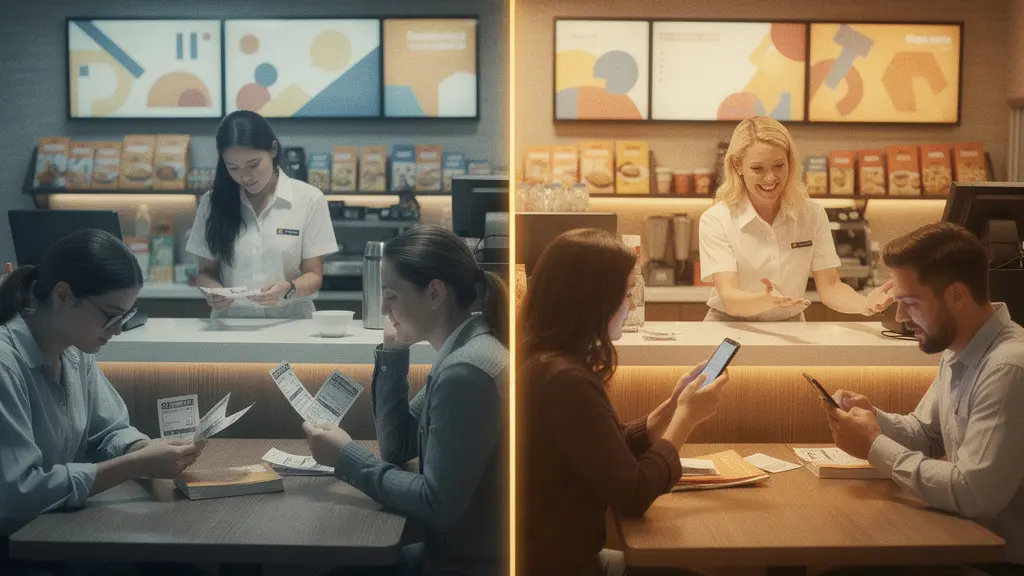
The key to long-term profitability is not acquiring more discount-seekers, but transforming their transactional data into operational intelligence that builds a high-margin, high-value customer relationship.
- Discount-driven traffic is a diagnostic tool to identify and fix flaws in your customer experience, not just a sales tactic.
- True loyalty is built on margin-protecting value (exclusivity, convenience) rather than an endless cycle of promotions.
Recommendation: Shift your focus from the cost of a coupon to the operational insight it provides. Use that data to systematically upgrade your customer journey and convert deal-seekers into full-price advocates.
As a franchisee, you’re caught in a constant battle. Corporate pushes for customer acquisition, often through aggressive discounting and coupon campaigns. You see the short-term traffic, but you also see the margin erosion and the influx of “one-and-done” customers who vanish the moment the deal expires. You’re left wondering if you’re building a business or just funding a revolving door of deal hunters.
The conventional wisdom is to double down: launch a points program, send more email offers, or simply offer “better customer service.” But these are often just different flavors of the same transactional mindset. They treat the symptom—a lack of repeat business—without diagnosing the underlying disease: a customer experience that isn’t compelling enough to command full price. This approach keeps you on the discount treadmill, perpetually buying loyalty that is never truly owned.
But what if the very data from these coupon hunters held the key to breaking the cycle? What if the true strategy wasn’t about out-discounting the competition, but about using transactional behavior as a diagnostic tool? The path to creating lifetime brand advocates is not paved with more coupons. It’s built by meticulously analyzing customer interactions to identify operational weaknesses, adding margin-protecting value, and strategically bridging the gap between a first-time discount and a full-value relationship.
This guide will provide a strategic framework for franchisees to do just that. We will deconstruct the journey from a single coupon scan to a loyal, high-LTV customer. We will explore how to make corporate programs work at a local level, leverage customer feedback for operational improvements, and master the art of the upsell to build a resilient and profitable customer base.
To navigate this strategic shift from discounts to lifetime value, this article is structured to address the most critical leverage points for a franchisee. The following sections provide a clear roadmap for transforming your customer engagement and profitability.
Summary: How to Turn One-Time Coupon Hunters Into Lifetime Brand Advocates?
- Why Are Only 15% of Your Customers Scanning the App and How to Fix It?
- How to Add a “Local Touch” to a Standardized Corporate Reward Program?
- The “We Miss You” Campaign That Recovers 10% of Churned Customers
- Discounts vs. Value Adds: Which Strategy Builds Real Loyalty Without Killing Margin?
- How to Use Negative Reviews to Identify the Exact Operational Flaw to Fix?
- How to Test the CRM’s Automation Capabilities Before Signing the Contract?
- The Upsell Script: Converting a Discount Customer into a Full-Ticket Sale
- How to Run a “Buy One Get One” Promo Without Killing Your Food Cost?
Why Are Only 15% of Your Customers Scanning the App and How to Fix It?
Low app adoption is rarely a customer problem; it’s an execution problem. If your scan rate is hovering around 15%, it signals significant friction in the in-store experience. The data is clear: customers are willing to engage digitally. A 2024 survey confirms that 52% of consumers use mobile wallets to store coupons, and 54% have made purchases based on those offers. The issue isn’t their willingness, but your process. The moment of payment is the most stressful part of the transaction, and any delay or confusion caused by the app will lead to abandonment.
The primary culprits are often twofold: inadequately trained staff and a lack of a fallback system. If your team can’t quickly and confidently guide a customer through the scan process, or worse, seems annoyed by it, you create a negative feedback loop. Customers will feel they are an inconvenience and won’t bother trying again. Furthermore, relying solely on a flawless app experience is a recipe for failure. Poor connectivity, dead phone batteries, or customers without smartphones should not disqualify them from participating.
To fix this, the focus must shift from simply having an app to operationalizing its use. First, implement micro-learning modules for staff that focus on confident, efficient app demonstration. Role-play scenarios where they handle common issues. Second, create and celebrate success. Institute gamified competitions between your locations, awarding recognition to the franchise with the highest app scan rates. This makes adoption a team goal, not a customer chore. Finally, and most critically, deploy a robust fallback system using a phone number lookup. This ensures no customer is left behind and shows that you value their loyalty, not just their tech-savviness. By removing these operational frictions, you make participation seamless and demonstrate that the program is designed for the customer’s benefit, not their burden.
How to Add a “Local Touch” to a Standardized Corporate Reward Program?
A standardized corporate rewards program often feels impersonal, offering generic points that lack a real connection to the customer’s community. For a franchisee, this is a missed opportunity. The key to elevating a one-size-fits-all program is to inject hyper-local relevance. This means building a network of value that extends beyond your own four walls and integrates your brand into the daily life of your local customers. Instead of just offering another free coffee, you offer a reward that enhances their lifestyle and strengthens community ties.
This strategy involves creating partnerships with other non-competing local businesses—the neighborhood gym, the independent bookstore, the local cinema. By cross-promoting and offering integrated rewards, you create a loyalty ecosystem. A customer might earn points at your location that unlock a discount at the yoga studio next door, or vice-versa. This accomplishes two critical goals: it dramatically increases the perceived value of your loyalty program without you having to fund every reward, and it positions your franchise as a central hub of the community.
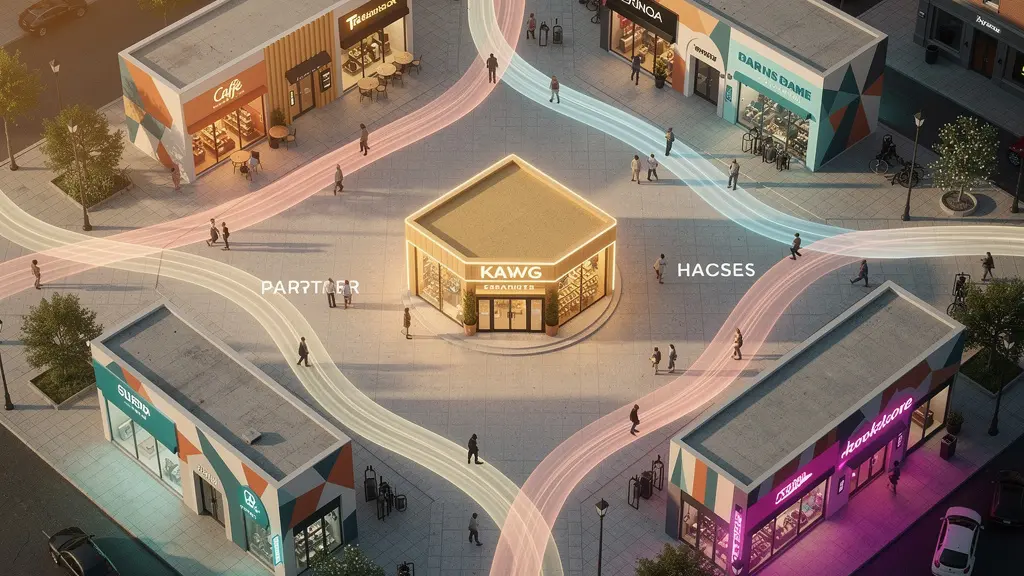
As the visualization above suggests, your franchise can become the glowing center of a connected commercial ecosystem. This model turns your loyalty program from a simple discount mechanism into a powerful customer acquisition and retention engine fueled by community goodwill. The success of this approach is well-documented and provides a clear blueprint for franchisees.
Case Study: Orange Wednesdays’ Localized Loyalty Success
Orange UK mobile created a highly successful local partnership program offering 2-for-1 movie tickets and pizza deals on Wednesdays. This hyper-local approach not only retained existing customers but actively attracted new ones, proving that franchisee-specific partnerships can drive both acquisition and retention when integrated into a corporate loyalty framework.
The “We Miss You” Campaign That Recovers 10% of Churned Customers
Not all lost customers are lost for the same reason. A blanket “We Miss You” email with a 10% off coupon is a low-effort, low-return strategy. It fails to address the root cause of churn and often rewards the wrong behavior. A customer who left due to a poor experience won’t be won back by a meager discount, and a seasonal shopper was never truly “lost” to begin with. The cost of getting this wrong is high; research highlights that 59% of U.S. customers will completely abandon a company they love after several negative interactions. A strategic recovery campaign, therefore, begins with segmentation.
To effectively recover churned customers, you must first categorize them based on their past behavior. The “faded regular” who used to visit weekly is a different asset than the “one-time deal seeker” who only showed up for a BOGO offer. Each segment requires a tailored approach, with an offer designed to address their specific reason for lapsing. A high-value, non-discount offer (like a free premium item) is often more effective for winning back a disillusioned regular than a simple percentage off. For the deal seeker, the goal is to re-engage them with a full-margin product trial, not another discount.
The following table, based on an analysis of re-engagement strategies, provides a clear framework for segmenting your lapsed customers and designing offers with a higher probability of success. By moving away from a one-size-fits-all approach, you can create targeted campaigns that speak directly to each customer’s value and motivation, significantly increasing your recovery rate.
| Customer Segment | Churn Timeframe | Recommended Offer Type | Expected Recovery Rate |
|---|---|---|---|
| Faded Regulars | 3-6 months inactive | High-value non-discount (free item) | 15-20% |
| One-Time Deal Seekers | After first purchase | Full-margin new product trial | 5-8% |
| Seasonal Customers | Off-season period | Early access to seasonal menu | 10-12% |
Discounts vs. Value Adds: Which Strategy Builds Real Loyalty Without Killing Margin?
The core tension for any franchisee is the pull between driving traffic with discounts and protecting profitability. While coupons can attract customers, they also train them to devalue your product and wait for the next promotion. True loyalty, the kind that translates to higher Lifetime Value (LTV), is rarely built on price. It’s built on a foundation of perceived value that goes beyond the monetary. The goal is to shift from margin-killing discounts to margin-protecting value-adds.
Value-adds are non-monetary or low-cost benefits that enhance the customer experience and create a sense of exclusivity and recognition. These can include operational perks like skip-the-line passes or priority reservations, which offer convenience. They can also be experiential, such as early access to new products, invitations to members-only events, or personalized recognition on a birthday or anniversary. The power of these rewards lies in their high perceived value and low operational cost. A “first-to-try” privilege costs you very little but can make a loyal customer feel like a true VIP.
This isn’t just a theoretical concept; customer preference data backs it up. Research reveals that while points are popular, other forms of value are equally, if not more, compelling. 72% of customers value early access to sales and products, a figure that rivals the appeal of straightforward discounts. This proves that customers are receptive to rewards that offer status and exclusivity. The franchisee’s task is to create a “margin impact matrix” that balances the cost of a reward with its perceived value, systematically testing and implementing value-adds like VIP status tiers and hybrid rewards that combine a small discount with a high-value experience. This strategic shift moves the conversation from “how much can I give away?” to “how can I make my best customers feel special?”.
How to Use Negative Reviews to Identify the Exact Operational Flaw to Fix?
Negative reviews are not a public relations crisis; they are a free source of high-quality operational intelligence. While it’s tempting to focus on the individual complaint, the real value lies in aggregate data. A single bad experience could be an anomaly, but recurring themes across dozens of reviews point to a systemic, and therefore fixable, operational flaw. Ignoring this feedback is costly, as dissatisfied customers are far more vocal than satisfied ones. Your goal is to transform a stream of unstructured complaints into a precise diagnostic tool.
The process begins with categorizing feedback. Instead of reading reviews as stories, parse them for keywords and recurring pain points. Are customers consistently mentioning “long wait times,” “cold food,” “confusing menu,” or “unfriendly staff”? These keywords are signals of specific breakdowns in your service delivery chain. By tagging and tracking the frequency of these themes, you can move from anecdotal evidence to hard data, identifying the one or two critical flaws that are causing the most customer friction and reputational damage.

Once you have identified the primary flaw—for instance, “slow service during lunch rush”—you can implement a targeted operational fix. This could involve re-evaluating staffing levels, streamlining the order-taking process, or investing in better kitchen equipment. The beauty of this approach is its direct impact. By fixing the root cause of the negative reviews, you not only prevent future complaints but also improve the experience for all customers, turning a source of frustration into a catalyst for excellence. This is the essence of using transactional data as a diagnostic tool.
Your 5-Step Negative Review Audit Plan
- Channel Audit: List all platforms where customers leave reviews (Google My Business, Yelp, app store, social media comments) to create a complete picture of your digital feedback footprint.
- Data Aggregation: Systematically inventory recurring keywords and themes from negative reviews over the past 90 days. Group them into categories like “Service Speed,” “Product Quality,” or “Staff Attitude.”
- Brand Promise Gap Analysis: Confront the top 2-3 complaint themes with your brand’s core values and service promises. Where is the disconnect between what you promise and what you deliver?
- Sentiment Root Cause Analysis: Look beyond the surface issue to identify the core emotion driving the review (e.g., “The order was wrong” might stem from a feeling of being ignored or disrespected).
- Operational Fix Plan: Develop a prioritized, one-page action plan to address the single biggest operational flaw you’ve identified, with clear metrics to track improvement.
How to Test the CRM’s Automation Capabilities Before Signing the Contract?
Choosing a CRM for a franchise network is a high-stakes decision. A system that looks great in a sales demo can quickly become an operational nightmare if its automation capabilities can’t handle the unique complexities of a franchise structure. Before signing any contract, you must conduct a rigorous “stress test” that simulates real-world franchisee scenarios. A generic test is useless; you need to verify that the CRM can support, not hinder, the delicate balance between corporate consistency and local autonomy.
The first critical test is for local override capabilities. Can an individual franchisee easily pause a corporate-level email campaign to run a hyper-local promotion for a community event? If the system is too rigid, it will stifle the local marketing efforts that are crucial for community engagement. Next, you must rigorously validate data segregation. Run a test to ensure, without a shadow of a doubt, that one franchisee can never access the customer data of another. A breach here is a legal and trust catastrophe waiting to happen. This test should be non-negotiable.
Beyond data governance, the stress test must focus on technical integration and performance. Verify that the CRM can connect seamlessly with the Point-of-Sale (POS) systems used across your network, which may vary from location to location. A clunky or unreliable POS integration will doom your loyalty program from the start. Finally, measure the real-time data synchronization speed. When a customer earns points at one location, that data should be reflected in their profile and available at another franchise location within seconds, not minutes or hours. To do this effectively, run your tests using at least three distinct franchisee profiles: a high-performing urban store, a struggling suburban location, and a multi-unit owner. This will reveal how the system performs under different levels of stress and complexity, giving you a true measure of its capabilities before you commit.
Key takeaways
- Lasting loyalty is built by converting customer data into operational improvements, not by offering endless discounts.
- Effective loyalty programs blend corporate standards with hyper-local value, making the experience relevant to the customer’s community.
- The most profitable customer journey is one that strategically upsells a discount-seeker into a full-margin, high-value relationship.
The Upsell Script: Converting a Discount Customer into a Full-Ticket Sale
The moment a customer redeems a coupon is not the end of a transaction; it is the beginning of a crucial conversation. This is your single best opportunity to build an upsell bridge from a discount-motivated visit to a long-term, full-value relationship. The goal is to immediately reframe their next visit, moving their focus from “where’s the next coupon?” to “what’s the value of being a member?”. An effective upsell at this stage is the most direct path to increasing customer LTV.
The psychology behind this is simple: you are leveraging their positive feeling from getting a deal to introduce a more sustainable path to value. The key is to present the loyalty program not as another hoop to jump through, but as a “smarter” way to get rewarded. The motivation is already there; research shows that 64% of loyalty program members spend more money just to maximize their point earnings. Your script should tap into this desire for optimization.
The script itself should be brief, friendly, and benefit-oriented. It’s not a hard sell; it’s a helpful suggestion. The staff member handling the transaction is your frontline ambassador for this conversion. They should be trained to deliver the message with confidence. As the following example from a best-practice training manual shows, the language positions the loyalty program as the superior, “insider” alternative to chasing coupons.
Glad you enjoyed the coupon. For your next visit, if you join our free loyalty program now, you’ll get exclusive value-adds, no coupon needed.
– Franchise Training Manual, Best Practices for Upselling to Loyalty Programs
This simple script elegantly pivots the conversation. It acknowledges their savvy in using a coupon but immediately presents a better, more exclusive path forward. It replaces the discount mindset with the promise of ongoing, insider value, effectively building the bridge to their next, full-price purchase.
How to Run a “Buy One Get One” Promo Without Killing Your Food Cost?
The “Buy One, Get One” (BOGO) promotion is one of the most powerful customer acquisition tools, but it’s also one of the most dangerous for a franchisee’s bottom line if executed poorly. A poorly planned BOGO can decimate your food cost and attract low-value customers who never return. However, when run strategically, a BOGO can be a margin-aware tool for driving trial of specific products and acquiring new, high-potential customers. The secret is to stop thinking of it as “giving away a free item” and start thinking of it as a strategic investment in product introduction and customer data acquisition.
The first rule of a profitable BOGO is to never let the customer choose the “get one free” item from your entire menu. The free item should always be a high-margin, low-cost product. This allows you to maintain control over your food cost percentage. The “buy one” item, conversely, should be a popular, traffic-driving product. This combination ensures you are attracting customers with a popular item while fulfilling the promotion with a product that has minimal impact on your margin. This is a fundamental principle of promotion profitability.
Furthermore, the most advanced BOGO strategies tie the promotion directly to a business objective, such as launching a new product. By making the BOGO offer exclusive to a new menu item, you are essentially subsidizing customer trial and gathering valuable initial feedback. This transforms the promotion from a simple discount into a powerful market research tool.
Case Study: Strategic BOGO Implementation at Scale
ShopRite’s digital coupon program demonstrates how BOGO promotions can be strategically paired with mobile wallet integration for seamless redemption. By carefully selecting high-margin items as the ‘free’ component and traffic-driving products as the ‘buy’ item, franchises can maintain profitability while driving customer acquisition. Their system achieved measurable success by focusing BOGO offers exclusively on new product launches, effectively using the promotion to guarantee trial for new products.
To put these strategies into practice, the next logical step is to stop viewing your customer base as a cost center and start managing it as your most valuable asset. Begin by auditing your current loyalty efforts through the lens of operational intelligence and margin-protecting value to transform your franchise’s profitability today.