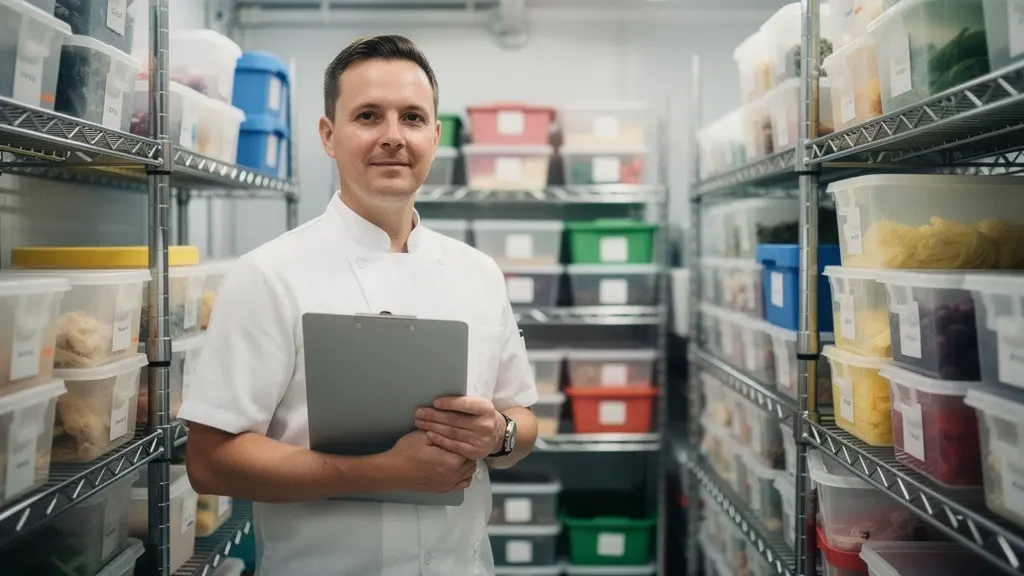
The key to a successful opening order isn’t perfect forecasting, but a disciplined system designed to minimize initial risk and financial waste.
- Prioritize a “Minimum Viable Inventory” (MVI) of core, multi-use ingredients instead of a full menu stock.
- Leverage soft openings not just for practice, but as critical opportunities to gather real, actionable demand data.
Recommendation: Treat your first purchase order as a calculated baseline to be iterated on, not an irreversible final prediction. Your goal is control, not clairvoyance.
The storeroom is full. Shelves are packed with produce, proteins, and dry goods. Yet, the dining room is empty, the doors are still locked, and the clock is ticking. This is the new owner’s quiet nightmare: a mountain of cash tied up in inventory that is expiring before the first customer even arrives. The common advice is to “forecast sales,” a useless platitude when you have zero sales history. Others suggest simply building good relationships with suppliers, which, while important, doesn’t solve the immediate tactical problem of a massive, speculative first order.
The truth is, trying to perfectly predict demand for an unproven concept is a fool’s errand. It leads directly to overbuying, waste, and a critical cash flow hemorrhage right at the most vulnerable stage of your business. The goal isn’t to guess correctly. It is to build a resilient system that allows you to be wrong on a small, manageable scale and correct course with precision. This requires a shift in mindset from speculative purchasing to disciplined, data-driven control from day one.
This guide abandons guesswork. We will dissect a waste-averse framework for your opening inventory. We will cover how to negotiate credit terms to preserve cash, manage the logistical chaos of initial deliveries with no staff, master corporate ordering portals to prevent errors, and implement a ruthless SKU triage to separate the mandatory from the optional. Finally, we will establish protocols for organizing your stock and handling supplier disputes, ensuring your inventory is an asset, not a liability.
This article provides a structured approach to navigate these challenges. The following sections detail the exact steps to take control of your opening inventory, minimize waste, and protect your startup capital.
Summary: How to Set Up Your Opening Inventory Order Without Overbuying Perishables?
- Net-30 vs. COD: How to Negotiate Credit Terms as a New Business Entity?
- The Loading Dock Bottleneck: Scheduling Deliveries When You Have No Staff Yet
- Mastering the Portal: How to Avoid Ordering Errors in the Corporate System?
- Mandatory vs. Optional: Which SKUs Should You Skip on Your First Order?
- Shelving Logic: How to Organize Your Stockroom to Minimize Counting Time?
- The Receiving Mistake That Costs the Average Unit $500 a Month
- The “Stock-Out” Nightmare: How to Forecast Inventory for an Unpredictable Opening?
- How to Handle a Dispute When the “Mandatory” Supplier Sends Bad Product?
Net-30 vs. COD: How to Negotiate Credit Terms as a New Business Entity?
For a new business, cash flow is oxygen. Paying Cash on Delivery (COD) for your initial large inventory order can suffocate your business before it even takes a breath. With startup costs that can reach an average of $375,000 for moderately sized full-service restaurants, preserving every dollar of working capital is non-negotiable. Your primary objective is to secure Net-30 payment terms, which gives you a 30-day window to generate revenue from the inventory before the bill is due. This fundamentally changes your financial risk profile.
Suppliers are hesitant to extend credit to new entities with no payment history. To overcome this, you must operate from a position of professionalism and preparedness. A comprehensive business plan with detailed financial projections is not just a document for investors; it’s your primary negotiation tool. It demonstrates your ability to repay and shows the supplier you are a serious, organized partner, not a flight risk. Go further by calculating your expected sales volumes and establishing inventory par levels to show you are ordering strategically, not guessing.
Never accept the first offer. Propose a tiered approach: perhaps a smaller initial COD order to build trust, followed by a transition to Net-15, and then Net-30 terms after a short period of consistent payments. Frame it as a partnership. Remind them that your success is their success, leading to larger, more frequent orders in the future. If direct negotiation fails, remember that options like SBA loans often provide better interest rates and longer repayment terms, which can be used to finance initial stock without depleting your primary cash reserves.
The Loading Dock Bottleneck: Scheduling Deliveries When You Have No Staff Yet
Your grand opening is weeks away, but the first trucks are arriving. Without a full team, receiving thousands of dollars in goods can quickly descend into chaos, leading to misplaced items, unverified counts, and spoiled product. The solution is a structured, preemptive approach to logistics. Your initial inventory costs can range from $5,000 to $25,000, an investment that demands a formal receiving strategy, not an improvised one.
First, designate a single individual as the “Receiving Captain.” This person is the sole point of contact for all suppliers and delivery drivers. Their responsibility is to own the schedule and the verification process, eliminating confusion. They must create a staggered “Delivery Matrix,” a schedule that prioritizes deliveries based on storage requirements and handling time. The logical flow is non-negotiable: frozen goods first (requiring immediate transfer to freezers), followed by refrigerated items, and finally, dry goods which are the most stable.
Do not let your first real delivery be a live-fire drill. Successful operators run simulated receiving sessions with a skeleton crew before any product arrives. This practice identifies bottlenecks in your stockroom flow and clarifies roles. Schedule all actual deliveries for quiet periods, typically early mornings, to ensure the Receiving Captain can perform accurate counts without distraction. Trying to receive a major food order during the chaos of pre-opening training or construction is a recipe for costly errors.
Mastering the Portal: How to Avoid Ordering Errors in the Corporate System?
Corporate ordering portals are designed for efficiency, but for a new owner, they can be a minefield of potential errors. A single misplaced decimal point or incorrect unit of measure (ordering a case instead of a single unit) can lead to massive over-purchasing and waste. The first defense is to reject manual systems. Relying on spreadsheets is slow, prone to human error, and simply cannot scale. A modern, POS-integrated digital system is a mandatory tool for accuracy.
These systems provide real-time updates and automated tracking, drastically reducing the risk of manual data entry mistakes. Before placing your first order, dedicate time to “sandbox” the system. Enter test orders, understand how unit conversions work (e.g., pounds to ounces, cases to eaches), and learn where to find critical SKU information. Do not learn the system under the pressure of a real deadline. The initial configuration time is a small price to pay to avoid thousands of dollars in ordering errors.
This table illustrates why abandoning manual methods is a critical first step for any new business focused on control.
| Aspect | Manual System (Spreadsheets) | Digital System (POS-Integrated) |
|---|---|---|
| Setup Time | Quick to start | Requires initial configuration |
| Accuracy | Prone to human error | Real-time updates, automated tracking |
| Cost | Low initial cost | Higher upfront investment |
| Scalability | Limited, becomes complex | Easily scales with business |
| Features | Basic counting and calculations | Automated reorder alerts, recipe costing, mobile counting |
A focused manager utilizing a digital platform can confidently verify inventory levels, cross-reference them with pars, and execute a precise order. This level of control is simply unattainable with a pen and paper.

As the image demonstrates, modern inventory management is about leveraging technology to make informed, data-backed decisions. This allows you to move from reactive counting to proactive control, preventing errors before they impact your bottom line. Master the portal, and you master one of the biggest risks in your opening phase.
Mandatory vs. Optional: Which SKUs Should You Skip on Your First Order?
A new menu is a list of possibilities, but your first inventory order must be a list of non-negotiable necessities. The fear of disappointing a customer with a “stock-out” often drives new owners to order one of everything. This is a critical error. The goal is to establish a Minimum Viable Inventory (MVI)—the absolute leanest collection of SKUs required to execute the core of your menu. Everything else is optional and should be skipped.
The “80/20 rule” is your guiding principle here: you must assume that 80% of your initial sales will come from 20% of your menu items. Your task is to identify that critical 20%. Prioritize core ingredients that are used across multiple menu items. A specific spice for one niche dish is an optional SKU; chicken breast or onions used in five dishes are mandatory. This cross-utilization provides menu flexibility while minimizing inventory diversity and risk.
Any item with a shelf life under seven days is a high-risk candidate for your “skip” list. Do not order delicate microgreens, specialty seafood, or short-dated dairy until you have at least one week of real sales data. This data will tell you what is actually selling, replacing your forecast with facts. Ordering these items from the start is pure speculation and a direct path to the dumpster. A disciplined, phased approach is the only way to protect your capital.
Your Action Plan: Prioritizing Your Opening SKU Order
- Focus on core ingredients used across multiple menu items to maximize flexibility and reduce unique SKUs.
- Apply the 80/20 rule: allocate 80% of your perishable budget to the 20% of ingredients that fuel your predicted top-selling dishes.
- Maintain a lean 3-7 days of service inventory, depending on your supplier’s delivery frequency and the item’s perishability.
- Systematically skip optional SKUs with a shelf life under 7 days until you have one full week of real sales data to justify their purchase.
- Analyze inventory turns; prioritize items with 4-8 turns per month, as this indicates fresher food and efficient management.
Shelving Logic: How to Organize Your Stockroom to Minimize Counting Time?
An unorganized stockroom is a hidden tax on your business. It wastes labor during inventory counts, increases the risk of spoilage by hiding older products, and makes finding ingredients during a busy service a stressful fire drill. Effective shelving logic isn’t about tidiness; it’s about creating a system that minimizes time and error. High-performing restaurants can complete a full inventory count in under an hour weekly, a feat only possible through rigid organization.
The system begins with grouping. All items must be grouped by category (dairy, meats, dry goods, chemicals) with consistent naming across all platforms—from the physical shelf labels to the SKU names in your POS. Within these categories, use the “First-In, First-Out” (FIFO) method without exception. This means all new deliveries are placed behind existing stock. To make this foolproof, every single item received must be labeled with its delivery date. This visual cue removes any guesswork about which product to use first.
Your shelving layout should mirror your order guide and inventory sheets. If the count sheet lists flour, sugar, then salt, the shelf should be organized in that exact order. This “mapping” allows staff to move down a single line, counting items without backtracking or searching, drastically reducing count times. Finally, use labeled bins and clear containers. Knowing what’s inside without having to open a box saves precious seconds during both service and stock-taking. This systematic approach transforms your stockroom from a chaotic cost center into an efficient, predictable asset.
The Receiving Mistake That Costs the Average Unit $500 a Month
The single most expensive mistake in the receiving process is complacency. It’s the habit of signing a bill of lading before every single item has been meticulously verified. This seemingly small shortcut can easily cost a restaurant hundreds, if not thousands, of dollars a month. With industry data showing that up to 10% of food inventory gets wasted before it even reaches a plate, a weak receiving protocol is like leaving your back door unlocked.
The mistake manifests in three common failures. First is failing to verify quantities, accepting the case count on the invoice as fact. Second is failing to check for quality, such as bruised produce or damaged packaging. The third and most critical failure is not verifying temperature. All refrigerated and frozen items must be checked with a temperature gun before they are accepted. A broken cold chain means the product’s shelf life is already compromised, and you are accepting spoiled goods. Once you sign that invoice, the product is yours, and so is the loss.
The non-negotiable receiving protocol is simple: never sign without complete verification. If there is any discrepancy—a shorted case, a damaged item, or a temperature out of the safe zone—you must document it immediately. Take a clear photo of the issue with the driver present. Note the discrepancy on the bill of lading before you sign it. This documentation is your only leverage for getting credit from the supplier. Without it, your claim is just your word against theirs, and you will almost certainly absorb the cost. This vigilance is not optional; it is a fundamental financial control.
The “Stock-Out” Nightmare: How to Forecast Inventory for an Unpredictable Opening?
The fear of an 86’d menu item on opening night drives many new owners to over-purchase. While stocking out is embarrassing, burning thousands of dollars on unsold, expiring inventory is a far greater business threat. Forecasting for an unpredictable opening isn’t about having a crystal ball; it’s about creating a structured, low-risk environment to gather real data. Food cost typically runs between 28-35% of revenue, and over-ordering on your initial buy can inflate that number to unsustainable levels.
The solution is a multi-phased opening strategy. Your “grand opening” should not be your first day of service. Instead, execute a series of soft openings.
- Run a 2-5 day “friends and family” soft opening 1-2 weeks before your official launch. This is your first real-world demand test.
- Use this low-pressure environment to track which items are popular and which are being ignored. This is your first real sales data.
- Instead of forecasting raw dollar amounts, use “sales per 100 customers” ratios from comparable units if you are part of a chain, or industry benchmarks if you are independent.
- This initial data allows you to make an informed, targeted inventory adjustment for the official grand opening.
This approach allows you to establish a three-tier PAR system. Start with a highly conservative “Week 1 PAR” for your soft opening. Use the data gathered to build a more realistic “Projected Week 2 PAR” for your grand opening week. Only after several weeks of consistent sales data should you establish your full-volume PAR levels. This iterative process replaces a single, high-stakes guess with a series of smaller, data-informed decisions, effectively de-risking your entire opening inventory strategy.
Key takeaways
- Adopt a “Minimum Viable Inventory” (MVI) strategy; prioritize core ingredients over a fully stocked menu to minimize initial cash outlay and risk.
- Implement a non-negotiable receiving protocol: verify quantity, quality, and temperature for every item before signing the invoice to prevent financial losses.
- Use soft openings as data-gathering tools to inform inventory adjustments, replacing speculative forecasts with real-world demand patterns before your grand opening.
How to Handle a Dispute When the “Mandatory” Supplier Sends Bad Product?
Even with mandatory or single-source suppliers, you are never obligated to accept substandard product. Receiving a shipment of wilted produce or near-expired dairy puts your menu quality and your customers’ safety at risk. Handling this situation effectively requires a firm, professional, and documented process, not an emotional phone call. Your goal is not just to complain but to achieve a specific resolution: credit for the bad product and an expedited replacement.
The moment you identify a problem, implement the “Isolate, Document, Escalate” protocol. First, immediately isolate the bad product from your main inventory to prevent it from being used accidentally. Second, document everything. Take clear photos of the damage, the expiration dates, and any relevant lot numbers on the packaging. This objective evidence is the foundation of your claim. Third, escalate the issue through the proper corporate channels. Do not just call the delivery driver; contact your designated account manager, who has the authority to resolve disputes.
When you communicate the issue, present a solution, not just a problem. State the exact quantity of compromised product and request a specific credit amount on your next invoice. If a replacement is needed urgently, provide a required delivery timeline. By leveraging your documentation and proposing a clear resolution, you shift from being a complainer to a professional partner seeking a remedy. Consistent audits of your own receiving procedures will help identify recurring issues, strengthening your case for future disputes and holding your mandatory suppliers accountable.
Apply these control systems from day one to protect your startup capital, minimize waste, and set your new business on a path toward long-term financial health and operational efficiency.