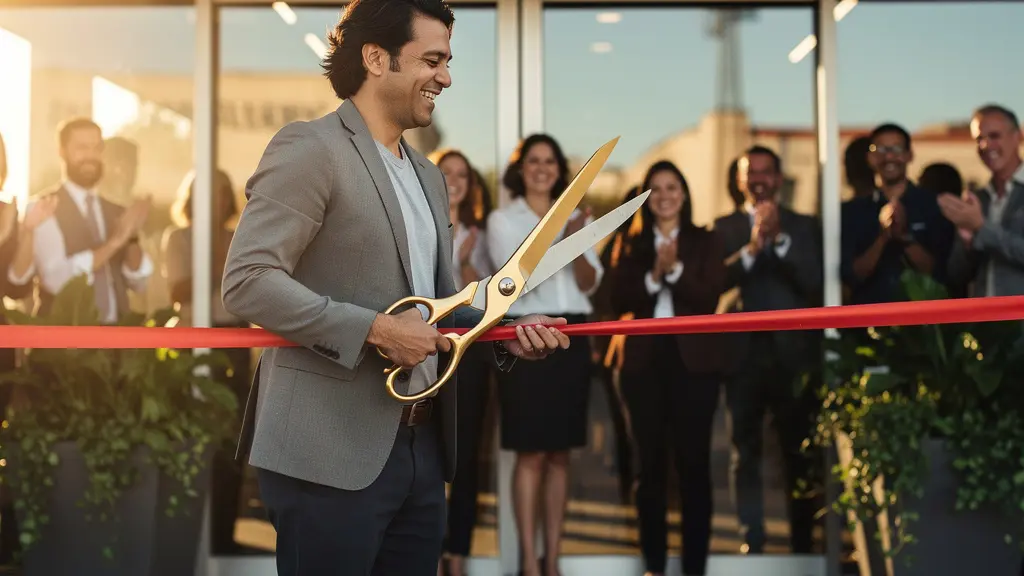
The fear of an empty store on opening day is a symptom of a flawed strategy, not a lack of marketing budget.
- Success relies on a dual-launch system: a private “soft open” to fix flaws and a public “grand open” for maximum impact.
- The primary goal isn’t just sales, but building a customer pipeline by systematically collecting hundreds of emails from day one.
Recommendation: Shift your focus from planning a one-day party to engineering an operational system that guarantees momentum from the moment your doors open.
The vision is clear: a line out the door, registers ringing, and social media buzzing with excitement. But for every new owner with this dream, a nightmare lurks—the deafening silence of an empty store. You’ve invested everything, and the thought of a launch day fizzle is terrifying. The common advice is predictable: post more on social media, offer some discounts, and hope for the best. This is a recipe for anxiety, not a strategy for success.
The truth is, a high-impact grand opening isn’t about luck or simply “getting the word out.” It’s about meticulous logistical planning. It’s a series of interconnected systems designed to de-risk your launch, guarantee foot traffic, and deliver a flawless customer experience under pressure. This isn’t just about surviving your first day; it’s about building the operational and marketing foundation for your first year.
Forget the generic tips. We are going to break down the core systems that transform a grand opening from a hopeful gamble into a predictable, revenue-generating machine. We’ll cover the two-date strategy that ensures perfection, the art of building a guest list that creates its own hype, the counter-intuitive staffing model that creates “wow” moments, and the inventory plan that prevents the dreaded “stock-out” nightmare. Most importantly, we’ll show you how to turn that initial surge of interest into a sustainable customer pipeline that fuels your growth long after the launch-day balloons have deflated.
This guide provides a detailed blueprint for executing an event with precision. The following sections break down each critical component, giving you the tools to move from fear to confident execution.
Summary: Your Blueprint for a Flawless Retail Launch
- Soft Opening vs. Grand Opening: Why You Need Two Dates to Ensure Perfection?
- How to Build a VIP Guest List That Guarantees Social Media Buzz?
- Overstaffing Strategy: Why You Should Double Your Crew for Opening Weekend?
- The “Stock-Out” Nightmare: How to Forecast Inventory for an Unpredictable Opening?
- How to Collect 500 Email Addresses During Your Opening Weekend?
- How to Convert National Super Bowl Ads into Foot Traffic for Your Specific Unit?
- How to Use “Coming Soon” Signage to Build a Waiting List Before You Open?
- How to Turn One-Time Coupon Hunters Into Lifetime Brand Advocates?
Soft Opening vs. Grand Opening: Why You Need Two Dates to Ensure Perfection?
The single biggest mistake a new retailer can make is treating their grand opening as a dress rehearsal. A public launch is a one-shot performance, and you cannot afford for your POS system to crash, your staff to seem confused, or your checkout flow to create a bottleneck. The solution is not to “hope for the best” but to implement a two-date launch strategy: a private soft opening followed by a public grand opening.
A soft opening is a controlled, invitation-only event held a few days or a week before your official launch. Its purpose is not to generate revenue but to stress-test every single one of your operational systems in a low-risk environment. This is where you discover that the Wi-Fi is spotty in the back of the store, that a product display is confusing, or that your new cashier needs more training on returns. Fixing these issues privately is professional; discovering them in front of a line of 200 impatient customers is a brand-killer. This focus on operational readiness is a key factor when you consider that while 71% to 85% of new businesses survive their first year, many early failures stem from correctable operational flaws.
Your guest list for this event should be strategic: friends, family, and other local business owners who you trust to give honest, constructive feedback. You are not trying to impress them; you are using them as a “beta testing” team. By operating at around 60% capacity, you give your team the space to learn and adapt without being overwhelmed. The soft opening is your insurance policy for a flawless grand opening.
- Set Clear Objectives: Define exactly what you need to test, from your POS systems and staff training to product displays and customer service protocols.
- Create an Invite-Only List: Keep it small (50-100 people) with trusted friends, family, and even local influencers who understand the goal is feedback.
- Gather Formal Feedback: Don’t rely on casual conversation. Use QR code surveys and physical comment cards at key touchpoints (fitting rooms, checkout) to capture structured input.
- Document Everything: Use photos and videos. What feels right in the moment might look cluttered on camera. This content can also be used for “behind-the-scenes” marketing later.
- Hold an Immediate Debrief: Schedule a team meeting within 24 hours to review feedback and create an action plan to implement improvements before the public launch.
This disciplined approach transforms your grand opening from a source of anxiety into a well-oiled machine ready to capitalize on the public’s excitement.
How to Build a VIP Guest List That Guarantees Social Media Buzz?
Social media buzz doesn’t happen by accident; it is engineered. While your grand opening is for the public, you need a targeted strategy to create a surge of excitement *before* and *during* the launch. This is achieved by curating a VIP guest list for a pre-opening event or for early access on launch day. This list isn’t about numbers; it’s about a person’s ability to amplify your message.
Your VIP list should be a strategic mix of individuals with influence in your local community. Forget chasing national celebrities; focus on the people whose opinions truly matter to your target customer. This includes:
- Local Micro-Influencers: People with 1,000-10,000 highly engaged local followers. Their posts feel authentic and are seen by the right audience.
- Neighboring Business Owners: Inviting the owner of the popular cafe next door creates goodwill and potential cross-promotional opportunities.
- Community Leaders: Think heads of local business associations, organizers of popular neighborhood events, or well-connected PTA presidents.
- Local Media & Bloggers: A reporter from the local paper or the writer of a popular neighborhood food blog can provide invaluable coverage.
The goal is to fill your store with people who are natural content creators. When they share their experience, it serves as a powerful, trusted endorsement. This approach is backed by data, as research shows that 60% of brands using influencer marketing increased their budget in 2024, with a significant shift towards local and micro-influencers for their high engagement and ROI.

By creating an exclusive, high-value experience for this curated group, you provide them with a story worth telling. This “engineered buzz” ensures that by the time your doors open to the public, there’s already a wave of authentic, positive social media content driving curiosity and foot traffic.
This isn’t just a party; it’s a targeted media campaign where your guests are the broadcasters.
Overstaffing Strategy: Why You Should Double Your Crew for Opening Weekend?
From a purely financial perspective, doubling your staff for opening weekend sounds crazy. But from an event planning and customer experience perspective, it’s the smartest investment you can make. The goal of a grand opening isn’t just to handle a crowd; it’s to create an overwhelmingly positive and memorable experience for every single person who walks through the door. A lean team can’t do that. A stressed, rushed team guarantees a poor experience.
An “overstaffing” strategy means you have enough people to not just perform core tasks, but to elevate the entire event. When one customer is at the register, another shouldn’t have to wait ten minutes to ask a question about a product. This surplus of staff allows you to designate roles beyond the basics. While some staff manage checkout and restocking, others become “Experience Roamers.” Their only job is to engage with customers, answer questions, offer refreshments, create shareable moments (like taking photos for guests), and gather real-time feedback. They are the human element of your brand, and they turn a transactional visit into a relational one.
This model prevents common launch-day failures: long checkout lines, a messy store, and unavailable staff. Each of these friction points detracts from the excitement and reduces the likelihood a customer will return. The table below outlines a typical staffing shift from a regular day to a grand opening, demonstrating how roles expand to prioritize experience over simple coverage.
This staffing model shows a clear shift in priorities. On a normal day, the goal is efficiency. On opening day, the goal is an exceptional experience. This strategic allocation of human resources is a direct investment in your brand’s reputation.
| Staff Role | Regular Day | Grand Opening | Purpose |
|---|---|---|---|
| Cashiers | 2 | 4-5 | Reduce checkout wait times |
| Floor Staff | 3 | 6-7 | Answer questions, guide customers |
| Experience Roamers | 0 | 2 | Create memorable moments, gather feedback |
| Content Capture | 0 | 1 | Document event for marketing |
| Stock Team | 1 | 3 | Continuous restocking |
Think of it not as overstaffing, but as “right-sizing” for a peak performance event. It’s the difference between merely surviving the day and truly owning it.
The “Stock-Out” Nightmare: How to Forecast Inventory for an Unpredictable Opening?
Running out of your most popular product on opening day feels like a good problem to have, but it’s not. It’s a logistical failure that disappoints customers and leaves money on the table. Forecasting for an event with no historical sales data is a massive challenge, but you can mitigate the risk with a “Hero Product” strategy. Instead of trying to perfectly predict everything, you focus your efforts on a few key items.
First, identify 3-5 “hero products.” These aren’t necessarily your most expensive items, but the ones that best represent your brand’s core value. They are the products you want everyone talking about. Once identified, your inventory strategy for these specific items becomes aggressive. While the rest of your inventory might be stocked at normal levels, you should aim to overstock your hero products by as much as 300%. The financial risk of over-ordering on a few SKUs is far lower than the brand risk of disappointing hundreds of first-time customers.
Beyond simple overstocking, your system should include several layers of protection:
- Real-Time Tracking: Your inventory management system must be flawless. Set up automatic reorder triggers that ping you or your supplier when a hero product hits a 30% stock level, giving you time to react.
- Planned Scarcity: For limited-edition or special launch-day items, communicate their exclusivity. A “sold out” sign on an item marketed as “only 50 available” creates hype; a surprise stock-out on a core product creates frustration.
- Emergency Supplier Agreements: Before the launch, negotiate an emergency restock agreement with your key suppliers. Even if it costs more for same-day delivery, having that option is a critical safety net.
- Pre-Order Data: If you’re building a pre-launch email list, offer exclusive pre-orders on hero products. This is the most accurate way to gauge real-world demand before you even open.
This focused approach turns inventory from a guessing game into a calculated strategy, ensuring your most important products are always available to make a great first impression.
How to Collect 500 Email Addresses During Your Opening Weekend?
The single most valuable asset you can build during your grand opening is not day-one sales, but your email list. A sale is a one-time transaction; an email address is a direct, permission-based line of communication for driving future sales. Aiming for a specific, ambitious number like 500 emails forces you to think systematically. You cannot achieve this goal with a simple clipboard at the checkout. You need a multi-touchpoint capture strategy integrated throughout the entire event experience.
The key is to offer value in exchange for an email at multiple points in the customer’s journey through your store. Each station provides a different incentive, capturing different segments of your audience. Some successful retailers have found that pre-launch landing pages with countdowns can build lists of 500-1000 subscribers even before the doors open, proving the power of a systematic approach. By combining digital and physical tactics, you create a robust customer pipeline from your very first day.
This requires equipping your team with tablets and using QR codes strategically. Make it a competition: offer a bonus to the team member who collects the most sign-ups. Gamifying the process for both staff and customers dramatically increases your success rate. A simple discount is good, but a tiered system that rewards deeper engagement is even better.
Your 5-Point Plan to Capture 500+ Emails
- Entrance Hub: Position a station at the entrance. Offer a digital event map or a guide to the day’s special promotions via a QR code that requires an email to unlock. This is your first and widest net.
- Product Deep Dive: Place QR codes near your “hero products.” The call to action is “Scan to unlock exclusive product info, tutorials, or a style guide.” This captures high-intent customers.
- Checkout Incentive: This is your most effective station. Offer an instant 10% discount on their current purchase for signing up. The immediacy of the reward leads to high conversion rates.
- Exit Survey: At the exit, have a final station with a call to action like, “Rate your experience for a chance to win a $100 gift card.” This captures those who may have missed other touchpoints.
- Staff as Ambassadors: Move beyond static stations. Equip your “Experience Roamers” with tablets to sign people up anywhere in the store, turning any conversation into a capture opportunity.
By engineering these collection points, you’re not just hosting an event; you’re executing a massive, in-person lead generation campaign.
How to Convert National Super Bowl Ads into Foot Traffic for Your Specific Unit?
Massive cultural events like the Super Bowl, a hit TV show finale, or a major awards ceremony are huge opportunities for agile local businesses. While you can’t afford a national ad, you can “draft” off the momentum of the big brands that can. This is called real-time event marketing, and it’s a powerful way to insert your local business into a national conversation, driving immediate foot traffic.
The strategy relies on speed and preparation. You’re not just watching the event; you’re treating it like a live trading floor. Before the event, your team should prepare a dozen pre-made social media post templates themed around potential ad categories (e.g., funny beer ads, emotional car ads, new movie trailers). During the event, you have a team assigned to monitor the commercials. The moment a major ad from a brand like Budweiser or Doritos airs, your team has 60 seconds to deploy your corresponding pre-made post, but with a localized twist.
For example: “That @Doritos ad was epic! The only thing that makes them better is [Your Product]. Show this post tonight for a free [Your Offer].” This makes your brand feel relevant and in-the-moment. The impact of this is significant, as social media analytics demonstrate that businesses leveraging major events see 55% higher engagement when using event-specific hashtags. You can amplify this further by using geo-fenced mobile ads triggered during commercial breaks within a 1-mile radius of your store, making the call to action immediate and local.
- Pre-Game Prep: Create 10-15 social post templates tied to likely ad themes.
- Live Monitoring: Assign team members to watch for specific brand ads during the event.
- Instant Response: Post your localized content within 60 seconds of a major ad airing, using the brand’s hashtag.
- Geo-Fencing: Run hyper-local mobile ads during commercial breaks with a simple, immediate offer.
- Partner Bundles: Team up with non-competing local businesses (e.g., a pizza place and a liquor store) for a “Game Day Package” to cross-promote.
By being prepared and agile, you can turn a multi-million dollar ad spend from a national brand into direct foot traffic for your local store.
How to Use “Coming Soon” Signage to Build a Waiting List Before You Open?
Your grand opening marketing doesn’t start the week before you open. It starts the moment you have a physical location. The period of construction or renovation is a prime marketing opportunity that most new owners waste. A simple “Coming Soon” sign is a missed opportunity. You need to implement a progressive signage narrative that builds curiosity and, most importantly, captures leads.
Instead of a single, static sign, think of your storefront as a multi-week billboard campaign. The goal is to tell a story and create a sense of anticipation in the neighborhood. This narrative approach slowly reveals information, keeping passersby engaged and wondering what’s next. Each week, the messaging evolves, culminating in a clear call to action that builds your crucial pre-launch email list.
This strategy turns passive foot traffic into an active, engaged audience before you’ve even sold a single product. It’s the very top of your sales funnel. The final and most critical piece is the QR code. This code should not link to a generic website homepage. It must direct to a dedicated landing page with a single purpose: capturing an email address in exchange for a compelling offer, like an invitation to your VIP pre-opening party or an exclusive “founding member” discount for the opening weekend. This transforms your physical signage into a 24/7 digital list-building tool.
A 4-week timeline for this campaign could look like this:
- Week 1 (Teaser): Install a mysterious, minimalist sign. “Something amazing is coming to this corner.” This sparks initial curiosity.
- Week 2 (Hint): Update the sign to add a category clue. “Your new favorite [coffee shop / bookstore / boutique] is opening soon.” This begins to qualify the audience.
- Week 3 (Reveal): A full brand reveal with your logo and name. Now you add the critical element: “Scan the QR code to join our VIP list for exclusive opening perks.”
- Week 4 (Countdown): Change the messaging to create urgency. “Only 7 days until we open! The first 100 visitors get a special gift.”
By the time you open, you won’t be introducing yourself to the neighborhood; you’ll be welcoming a crowd that has been waiting for you.
Key Takeaways
- A dual-launch (soft and grand opening) is non-negotiable for operational perfection.
- Success is engineered through systems: for buzz (VIPs), for experience (staffing), for supply (inventory), and for future sales (email).
- The primary goal of a grand opening is not just day-one revenue but building a robust customer pipeline for the long term.
How to Turn One-Time Coupon Hunters Into Lifetime Brand Advocates?
The grand opening was a success. The crowd came, the registers rang, and you have a list of 500 new email subscribers. The danger now is assuming the job is done. Many of those first-day customers were drawn in by hype and discounts—they are “coupon hunters.” The final, and perhaps most important, system you need is a 90-day post-launch customer journey designed to convert that initial interest into genuine, long-term loyalty.
Your goal is to methodically build a relationship beyond the transaction. This is done through an automated email sequence that delivers value, tells your brand story, and creates a sense of belonging. Instead of just sending more discount offers, you need to nurture these new leads. A critical component of this is connecting your brand to a larger mission. For instance, research reveals that 77% of consumers prefer buying from companies with strong Corporate Social Responsibility (CSR) practices, showing that shared values can be a powerful retention tool.
The journey should be a strategic drip of content that deepens the customer’s connection to your brand. By Day 30, you should be able to identify your most engaged new customers and elevate them to “Founding Member” status. This small, symbolic gesture, perhaps with a permanent small discount or early access to new products, transforms them from customers into advocates. They were there from the beginning, and that status makes them feel special and invested in your success.
- Day 1 (Thank You & Value): Send a personalized “thank you for celebrating with us” email. Include a “golden ticket” for a non-discount value-add on their second visit (e.g., a free consultation, a bonus gift).
- Day 7 (Brand Story): Share a video or letter from the founder. Explain the “why” behind your business and its mission.
- Day 30 (Create Exclusivity): Invite your best opening-day customers to become “Founding Members” with a permanent perk.
- Day 45 (Ask for Feedback): Send a survey asking for their opinion. This shows you value their input and provides you with crucial data.
- Day 90 (Celebrate & Recognize): Acknowledge their “90-day anniversary” as a customer. This reinforces their status as an early supporter.
To truly maximize the impact of your launch, the next logical step is to begin designing this 90-day customer journey. It’s the system that ensures your $10,000 opening day becomes the foundation for a $1,000,000 first year.