
Pivoting your service model isn’t about chasing trends; it’s about building an adaptive framework to validate change before making risky investments.
- Most pivots fail not because the idea is bad, but because the execution is a high-cost gamble instead of a low-risk experiment.
- Distinguishing a sustainable shift (a “signal”) from a temporary fad (a “noise”) is the most critical skill for a franchisee today.
Recommendation: Instead of asking “Should I adopt this trend?”, start asking “What is the cheapest, fastest way I can test this trend’s real-world impact on my bottom line?”
For any franchisee, the landscape can feel like a series of aftershocks. One moment, your established model is a well-oiled machine; the next, customer habits seem to shift overnight. Suddenly, everyone is asking about delivery apps, contactless payments, and eco-friendly packaging. The pressure to adapt is immense, fueled by industry reports and competitor movements. The common advice is to “be agile” and “listen to your customers,” but this often translates into a high-stakes guessing game. Do you invest tens of thousands in kitchen kiosks, or will the labor shortage ease? Do you overhaul your menu for a vegan audience that may or may not exist in your specific market?
This reactive approach is a recipe for cash flow anxiety. Many businesses make the mistake of mirroring massive corporate pivots, like Netflix’s legendary shift from DVDs to streaming, without having the same capital or risk tolerance. They see the “what” but miss the “how.” A successful pivot at the franchise level is rarely a single, dramatic leap. It’s a series of small, calculated steps that build operational resilience and test the waters before you dive in. The core of your business—your value proposition—may remain the same, but the delivery mechanism must become elastic.
The true challenge isn’t keeping up; it’s building a system to distinguish a fundamental market shift from a two-year fad. It’s about developing the capacity to test, learn, and integrate new service models without betting the entire business. This article moves beyond the ‘if’ and focuses on the ‘how’. We will explore a strategic framework for evaluating the major trends facing service businesses today, helping you make visionary decisions grounded in pragmatic, low-risk validation.
To navigate these complex decisions, we have structured this guide to address the most pressing questions franchisees face. Each section breaks down a specific trend, providing the data and frameworks needed to make intelligent, future-focused choices for your business.
Summary: How to Pivot Your Service Model When Customer Habits Shift Overnight?
- The Delivery Dilemma: How to Make Money When Apps Take 30% Commission?
- Green Business: Will Switching to Eco-Packaging Actually Bring New Customers?
- Kiosks vs. Cashiers: Is Automation the Answer to the Labor Shortage?
- Gluten-Free and Vegan: Is It a Niche or a Necessary Menu Update?
- Contactless and Crypto: Do You Really Need to Accept Bitcoin?
- How to Spot a Sustainable Trend vs. a 2-Year Fad Before Investing?
- When Will the Next $20,000 Mandatory Tech Upgrade Hit Your Cash Flow?
- How to Attend the Annual Convention Without It Just Being a 3-Day Party?
The Delivery Dilemma: How to Make Money When Apps Take 30% Commission?
The rise of third-party delivery apps presents a classic double-edged sword. On one hand, they offer immense visibility and access to a customer base you might not otherwise reach. On the other, they can decimate your margins. With commission rates that can reach 15% to 35%, you are essentially paying a heavy tax for every transaction. Simply absorbing this cost is unsustainable, but ignoring the delivery trend means becoming invisible to a significant portion of the market. The visionary approach is not to choose one or the other, but to build a hybrid model that leverages these platforms for acquisition while driving customers to more profitable, direct channels.
Think of third-party apps as your marketing department, not your primary sales channel. Their purpose is to introduce new customers to your brand. Once that introduction is made, your goal is to “own” that customer relationship. This means creating a compelling reason for them to order directly from you the next time. By implementing a strategic markup on app prices, you can offset the commission fees while making your direct-ordering prices inherently more attractive. The key is a seamless, user-friendly direct ordering system—whether through your website or a white-label app—that offers incentives like loyalty points or exclusive deals.
This strategy transforms your delivery operation from a low-margin necessity into a powerful customer acquisition funnel. You use the platforms’ reach to attract initial orders, then systematically convert those buyers into high-LTV (Lifetime Value) direct customers. This requires meticulous tracking and a commitment to nurturing the relationship beyond the first order. It’s a shift from being a passive participant in the delivery economy to an active architect of your digital storefront.
Green Business: Will Switching to Eco-Packaging Actually Bring New Customers?
The conversation around sustainability is no longer a fringe movement; it’s a mainstream expectation. For franchisees, the question is pragmatic: is the investment in more expensive, eco-friendly packaging a cost center or a genuine driver of customer acquisition and loyalty? The answer lies in viewing sustainability not as an operational line item, but as a powerful brand signal. While it’s true that many customers now prioritize eco-friendly practices, simply swapping plastic for paper isn’t enough. The pivot must be authentic and visible.
The visual and tactile experience of your packaging is a critical touchpoint. It communicates your brand’s values before the customer even tastes the product. High-quality, thoughtfully designed sustainable packaging can elevate the perceived value of your offering and create a memorable unboxing experience. It tells a story of responsibility and quality that resonates with a growing demographic willing to pay a premium for brands that align with their values. This isn’t just about being “green”; it’s about demonstrating a commitment to quality in every aspect of your business.

As the image above illustrates, the materials themselves—the texture of bamboo fiber, the sturdiness of recycled cardboard—become part of your brand identity. However, the financial return is not automatic. The pivot to sustainable packaging is most effective when it’s part of a broader marketing narrative. You must communicate this change across your channels, explaining not just what you’re doing, but why. This transforms a potential cost into a tangible marketing asset that can attract new customers, justify a slight price premium, and build the kind of deep brand loyalty that transcends transactional relationships.
Kiosks vs. Cashiers: Is Automation the Answer to the Labor Shortage?
The persistent labor shortage has forced many franchisees to consider automation, with self-service kiosks at the forefront. The initial reaction is often to see kiosks as a direct replacement for cashiers—a way to cut labor costs. However, this is a limited view. The true power of automation lies in its ability to optimize the entire customer experience and redeploy your valuable human staff to higher-impact roles. Kiosks are not just about saving money; they are about making more money and improving service simultaneously.
Data consistently shows that kiosks lead to higher average order values. Freed from the perceived judgment of a human cashier, customers are more likely to explore the menu, add extras, and respond to automated upsell prompts. For example, some reports indicate that McDonald’s saw a 30% increase in average check size after introducing kiosks. They ensure every customer is offered the upsell, every time, without fail. This consistency is something human staff, no matter how well-trained, cannot replicate during a busy rush. The table below, drawing from industry analyses, breaks down the multifaceted impact of this technology.
As this comparative analysis of kiosk adoption shows, the benefits extend far beyond a single metric. Faster processing, shorter queues, and a significant ROI make a compelling business case.
| Metric | Traditional Cashier | Self-Service Kiosk | Impact |
|---|---|---|---|
| Order Processing Time | Baseline | 40% faster | Reduced bottlenecks |
| Average Order Value | Standard | 15-30% higher | Consistent upselling |
| Queue Length | Standard wait | 25-40% reduction | Improved flow |
| ROI Timeline | N/A | 3-6 months | $50-100K investment |
| Customer Preference | When line < 4 people | When line > 4 people | 61% want more kiosks |
The most strategic pivot, therefore, is not to replace cashiers but to transform their role. With kiosks handling the transactional, repetitive task of order-taking, your staff can focus on hospitality: greeting guests, managing the floor, resolving issues, and ensuring a positive overall experience. This hybrid model leverages technology for efficiency and humans for what they do best: creating connection and solving complex problems.
Gluten-Free and Vegan: Is It a Niche or a Necessary Menu Update?
For years, dietary options like gluten-free and vegan were considered a niche market, catering to a small but vocal minority. Today, that perception is dangerously outdated. This isn’t just about allergies or ethical stances anymore; it’s about a massive, mainstream shift in consumer consciousness toward health and choice. Viewing this trend as a “niche” is a strategic error; it’s a fundamental market expansion. The question for a franchisee is no longer “if” but “how” to integrate these options profitably and without disrupting core operations.
The financial incentive is staggering. Projections show the plant-based food market is set to grow from $14.2 billion to $44.1 billion by 2035. Ignoring this segment is like refusing to serve a demographic the size of a small country. Furthermore, dietary needs often have a “veto vote” in group decisions. If one person in a group of ten is vegan, the entire group will choose a restaurant that can accommodate them. By offering compelling options, you don’t just capture one customer; you capture their entire network.
The key to a successful pivot is a phased, data-driven implementation. Don’t overhaul your entire menu overnight. Start small with two or three excellent, clearly marked options that are well-integrated into your existing menu. Crucially, this requires a serious commitment to preventing cross-contamination through separate prep areas and rigorous staff training. This builds trust and protects your brand. By monitoring sales data and customer feedback over a pilot period, you can make informed decisions about scaling your offerings, ensuring the pivot is guided by actual demand rather than guesswork.
Contactless and Crypto: Do You Really Need to Accept Bitcoin?
In the whirlwind of payment technology, it’s easy to get caught up in the hype. As a franchisee, you’re bombarded with pitches for the “next big thing,” from tap-to-pay to cryptocurrency. The visionary leader’s job is to separate the signal from the noise. The signal represents a fundamental, lasting shift in consumer behavior. The noise is the speculative, volatile trend that generates headlines but has little practical impact on your daily operations. In today’s landscape, contactless payment is the signal, while cryptocurrency remains, for most service businesses, the noise.
The adoption of digital and contactless payments is no longer a trend; it’s the standard. Consumers expect speed, security, and convenience at the checkout. In the delivery sector alone, it’s been shown that online payments accounted for over 79% of the market share in 2024. Failing to offer seamless tap-to-pay, mobile wallets, and online payment options introduces friction into the customer experience, which can directly lead to lost sales. This technology is a non-negotiable part of modern service infrastructure.
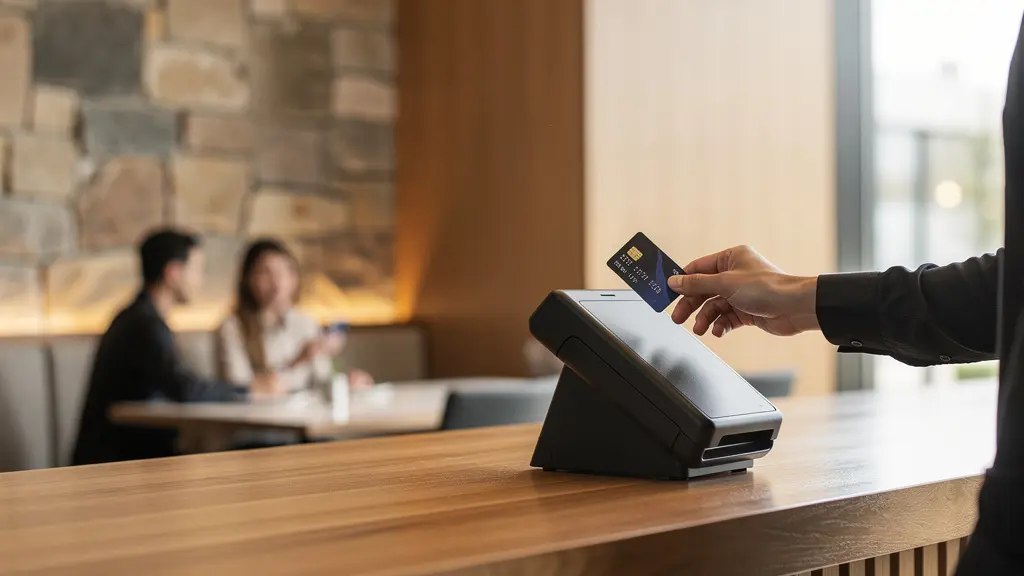
On the other hand, accepting cryptocurrencies like Bitcoin introduces significant complexity for minimal gain. The volatility, accounting challenges, and limited customer adoption make it a high-risk, low-reward proposition for the vast majority of franchises. While it might generate a temporary PR buzz, it doesn’t solve a real problem for most of your customers. The strategic pivot is to double down on perfecting your contactless infrastructure. Ensure it’s fast, reliable, and integrated across all your sales channels. Focus your resources on the proven signal, not the distracting noise.
How to Spot a Sustainable Trend vs. a 2-Year Fad Before Investing?
The million-dollar question for every franchisee is how to differentiate a lasting shift from a fleeting fad before committing significant capital. The fear of investing in the “next big thing” only to see it fizzle out is paralyzing. The answer is to stop thinking like an operator and start thinking like a venture capitalist: by making small, data-driven bets. You need a framework for low-cost validation. This is your system for filtering the signal from the noise.
A sustainable trend solves a real, persistent customer problem or satisfies a deep-seated desire. A fad is often a novelty without a strong underlying “why.” Consider the pivot of YouTube. It started as a video dating site, but the founders noticed users were uploading all kinds of videos—not just dating profiles. They recognized this user behavior as the true signal. By pivoting from their intended use to how the platform was actually being used, they tapped into the fundamental human desire to share and connect, a sustainable trend that led to a $1.65 billion acquisition. Their success came from observing real behavior, not forcing their initial idea.
Your franchise can apply the same principle on a smaller scale. Before you invest in a major overhaul, you must test the core hypothesis with minimal resources. Does the problem you’re trying to solve actually exist for your specific customers? Are they willing to pay for the solution? You don’t need a perfect, polished product to answer these questions. You need a Minimum Viable Product (MVP) or a simple experiment to gather real-world data. This is the cornerstone of building an adaptive, future-proof business.
Your 5-Step Framework for Validating a Trend
- Gauge Intent: Create a ‘Coming Soon’ landing page or run targeted social media polls to collect email sign-ups and measure initial interest before building anything.
- Validate the Problem: Conduct 20-30 brief customer interviews. Your only goal is to confirm the problem you think you’re solving is a real, recurring pain point for them, not just a minor inconvenience.
- Launch a Pilot: Run a minimum viable product (MVP) test with a minimal investment (e.g., under $500). This could be a single new menu item, a manual delivery service for one neighborhood, or a temporary ‘pop-up’ service.
- Track Engagement: Monitor key metrics for a 30-day period. Are people using it? Are they coming back? Is the feedback positive? Compare these results against your baseline criteria for success.
- Scale or Kill: Based on the data, make a clear decision. If the pilot shows strong positive signals, develop a plan for a phased, larger-scale rollout. If it fails, kill the idea and move on, having spent very little time and money.
When Will the Next $20,000 Mandatory Tech Upgrade Hit Your Cash Flow?
For a franchisee, a sudden, mandatory technology upgrade can feel like a punch to the gut. Whether it’s a new POS system, updated security protocols, or franchisee-wide software, these large, lumpy capital expenditures can wreak havoc on cash flow. With reports showing that 73% of restaurant operators increased their technology investments in 2024, it’s clear that the pace of change is accelerating. The question is not *if* the next big upgrade will come, but *how* you can structure your business to absorb it without derailing your finances.
This is where a strategic shift in thinking from Capital Expenditures (CapEx) to Operating Expenditures (OpEx) becomes a powerful tool for building model elasticity. Instead of purchasing technology outright, increasingly more services are available via a subscription model (Software-as-a-Service or SaaS). While the total cost of ownership over five years might sometimes be higher, the benefits in terms of cash flow, flexibility, and access to innovation are often overwhelming. A predictable monthly fee is far easier to budget for than a surprise $20,000 invoice.
The choice between buying and subscribing is a critical strategic decision with long-term implications, as detailed in this decision matrix for restaurant technology.
| Factor | Buy (One-time) | Subscribe (SaaS) | Strategic Consideration |
|---|---|---|---|
| Initial Cost | $20,000-50,000 | $200-500/month | Cash flow impact |
| 5-Year TCO | $25,000 (with maintenance) | $30,000 | Long-term value |
| Upgrade Flexibility | Limited | Continuous updates | Innovation access |
| Data Ownership | Full control | Vendor dependent | Strategic risk |
| Scalability | Hardware limited | Easily scalable | Growth potential |
By favoring subscription models where possible, you transform your technology stack from a rigid, depreciating asset into a flexible, scalable service. This approach ensures you always have access to the latest updates and features without the risk of your expensive hardware becoming obsolete. It’s a fundamental pivot that builds financial resilience and allows you to adapt to the next mandatory upgrade as a simple operational adjustment, not a financial crisis.
Key takeaways
- Pivoting is not a reaction, but a proactive capability built on low-cost validation.
- Distinguish between fundamental trends (signals) and temporary hype (noise) to avoid costly mistakes.
- Leverage technology like kiosks and SaaS models to create operational and financial elasticity in your business model.
How to Attend the Annual Convention Without It Just Being a 3-Day Party?
The annual franchise convention is often viewed as a mandatory social gathering—a mix of networking, rah-rah sessions, and evening parties. For the visionary franchisee, however, it is the single most important intelligence-gathering mission of the year. This is your opportunity to look beyond your own four walls and see the future of the industry taking shape. Attending without a clear strategic objective is a colossal waste of time and money. The goal is to return not with a hangover, but with a validated roadmap for your next pivot.
As The Strategy Institute notes in its research on business model transformation, the most effective pivots are not born from sudden inspiration. Instead, as their experts state, they are the result of disciplined analysis.
The most effective pivots happen after rigorous validation of new target segments, value propositions, and business models
– The Strategy Institute, Pivoting to Profit Research
Your mission at the convention is to conduct this “rigorous validation” in a condensed timeframe. This requires a structured approach. Before you go, define your key intelligence questions. Are you investigating new POS vendors? Trying to understand the real-world ROI of a new piece of kitchen equipment? Seeking a mentor who has already navigated a menu pivot? Assigning specific objectives transforms your purpose from passive attendee to active investigator. It means prioritizing breakout sessions on emerging tech over general keynotes and focusing networking conversations on learning, not just socializing.
The real work begins when you return. The insights gathered are useless unless they are translated into action. Schedule a debrief session with your team within 48 hours of your return to distill your findings into a concrete action plan. The most crucial step is to identify one small, sub-$500 idea or experiment that you can launch within 30 days. This creates momentum and turns the convention from a one-off event into a catalyst for continuous, intelligent evolution.
The ultimate goal is to transform your business from one that reacts to change to one that anticipates it. Start building your adaptive framework today by applying these validation principles to the next trend that crosses your desk, turning uncertainty into a competitive advantage.