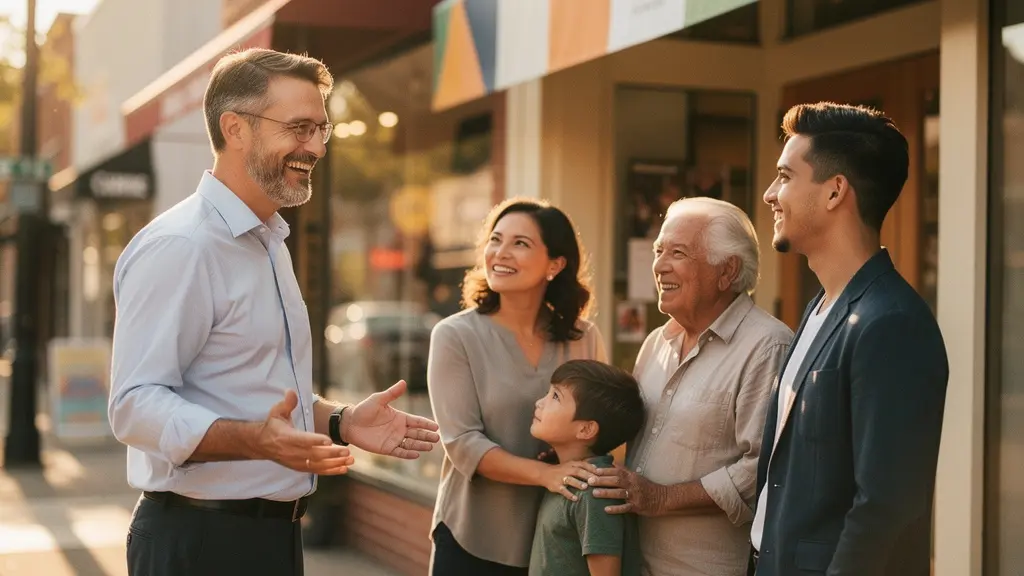
Becoming a local ‘Mayor’ isn’t about outspending competitors on ads or sponsorships; it’s about embedding your business into the very fabric of the community.
- Transform every business operation, from marketing to customer service, into a genuine, human-to-human relationship-building opportunity.
- Leverage your physical space and local partnerships to create a hub of community activity and mutual support.
Recommendation: Start by treating every interaction not as a transaction, but as a chance to build the trust and social capital that makes you indispensable.
For any local business owner, the daily reality is a constant fight for attention. You’re not just competing with the shop across the street, but with global e-commerce giants and the endless scroll of social media. The conventional playbook offers familiar advice: run a sale, boost a post, sponsor the local little league team, and hope for the best. These tactics can generate temporary buzz, but they rarely build the deep, lasting loyalty that makes a business truly unshakable.
This approach often overlooks the most powerful asset a local business has: its genuine connection to the community it serves. Building this connection is about more than just visibility; it’s about building social capital. It’s the trust you earn, the relationships you foster, and the goodwill you cultivate that ultimately makes price and proximity secondary factors for your customers. They don’t just shop with you; they support you because you are a vital part of their neighborhood’s identity.
But what if the true path to making competition irrelevant wasn’t about shouting louder, but about listening more intently and engaging more deeply? What if you could become the unofficial “Mayor” of your trade area—the go-to person, the trusted resource, the central hub of community life? This isn’t a fantasy; it’s a strategic shift in mindset. It means viewing every aspect of your business as an opportunity to strengthen your local roots.
This guide moves beyond the generic tips to provide a concrete framework for building that mayoral reputation. We’ll explore practical, relationship-driven strategies that transform everyday operations into powerful community-building tools, ensuring your business doesn’t just survive, but becomes an institution that your community can’t imagine living without.
For those who prefer a dynamic visual format, the following video offers a complementary overview of the core principles of commitment and dedication discussed in this guide.
To help you navigate these strategies, this article is structured around key pillars of community engagement. Each section provides actionable insights to help you build your local influence methodically and authentically.
Summary: The Playbook for Becoming Your Community’s Go-To Business
- Jersey Sponsorships: Are You Getting ROI or Just a Warm Fuzzy Feeling?
- Workshops and Classes: Using Your Space After Hours to Build Community
- The Fishbowl Method: How to Collect Emails at the Register Without Being Annoying?
- The Power of the Owner’s Call: Turning a 1-Star Review into a Lifetime Fan
- Chamber of Commerce: Is It Worth Your Time or Just a Breakfast Club?
- National Fame vs. Local Reputation: What Actually Drives Sales in Your Zip Code?
- Fundraiser Nights: How to Structure a Spirit Night That Actually Makes Money?
- How to Form a Purchasing Coop With Other Franchisees to Lower Prices?
Jersey Sponsorships: Are You Getting ROI or Just a Warm Fuzzy Feeling?
Sponsoring a local sports team is often the first step businesses take into community marketing. While seeing your logo on a jersey provides a “warm fuzzy feeling” of doing good, its real value is often misunderstood. The goal shouldn’t be a direct, immediate return on investment (ROI) in sales, but rather a long-term investment in social capital. It’s about aligning your brand with the community’s passions and becoming part of its story.
The mistake many owners make is treating sponsorship as a passive advertisement. True impact comes from activation. Instead of just writing a check, think of it as forming a partnership. This means moving beyond simple ROI and focusing on Return on Objectives (ROO). Are you trying to build brand awareness with families? Generate leads for a specific service? Or simply be seen as a pillar of the community? Clear objectives will dictate your activation strategy.
The impact of this long-term thinking is significant. While the immediate sales boost from a sponsorship might be modest, a Nielsen Sports study reveals that nearly 47% of a sponsorship’s total impact comes from long-term brand building effects like enhanced loyalty and positive perception. To achieve this, activate your sponsorship with co-branded social media campaigns, host “meet the team” nights at your location, or offer a special discount for ticket holders. These actions transform a simple logo into a living, breathing relationship between your business and the community.
Workshops and Classes: Using Your Space After Hours to Build Community
Your physical location is one of your most underutilized community-building assets. During business hours, it’s a place of commerce. After hours, it can become a relational hub—a gathering place that offers value beyond your products or services. Hosting workshops, classes, or local meetups transforms your business from a place people visit to a place where they connect. This shift is fundamental to becoming a “Mayor.”
This strategy also humanizes your business from the inside out. Your employees are not just staff; they are neighbors. In fact, a 2024 report from Power to Change found that 81% of staff in community businesses are local residents, making them natural ambassadors. Empowering them to lead a workshop on a topic they’re passionate about—even if it’s unrelated to your core business—builds their engagement and deepens their connection to customers.
Imagine a bookstore hosting a local author reading, a coffee shop offering a latte art class, or a hardware store running a DIY home repair workshop. These events provide genuine value, create memorable experiences, and position your business as a generous contributor to the community’s well-being. The image below captures the essence of this transformation.

As you can see, the focus is on connection and shared learning, creating positive associations with your brand that last far longer than any sales promotion. You’re not just selling goods; you’re facilitating community. This builds a powerful moat of loyalty that competitors simply cannot cross with a lower price.
The Fishbowl Method: How to Collect Emails at the Register Without Being Annoying?
Collecting customer information, like email addresses, is crucial for building long-term relationships. However, the typical ask—”Can I get your email for our newsletter?”—often feels transactional and intrusive. The “fishbowl” method, whether a literal glass bowl for business cards or a modern digital equivalent, can feel just as impersonal if not executed with a relationship-first mindset. The key is to reframe the entire proposition from a one-way marketing blast to an invitation to an exclusive club.
Instead of asking customers to “join our mailing list,” invite them to “become a Neighborhood Insider.” This subtle shift in language changes the dynamic entirely. You are no longer taking something from them; you are offering them privileged access. The value proposition must be clear and immediate: insiders get first notice of new products, exclusive access to events, or special community news that no one else receives. The goal is to build a micro-community, not just a marketing database.
To make this work, the process must be frictionless and value-driven. Partnering with other non-competing local businesses to create a “Local Best” prize package can significantly increase participation. A chance to win dinner at the restaurant next door and a gift certificate from your shop creates a web of local reciprocity. It shows you’re a connected, collaborative part of the neighborhood—a true “Mayor” who brings people together. This approach turns a simple data collection point into another pillar of your community engagement strategy.
Action Plan: Building Your ‘Neighborhood Insider’ List
- Reframe the ask: Position your list as an invitation to “Become a Neighborhood Insider” rather than just a mailing list. Clearly display the exclusive benefits.
- Add value checkboxes: Allow subscribers to self-segment by offering choices like “Events,” “Special Offers,” or “Community News” to ensure they only receive relevant content.
- Partner for prizes: Collaborate with neighboring businesses to create “Local Best” prize packages, enhancing the incentive to sign up and building B2B relationships.
- Set clear expectations: Be transparent about email frequency and the kind of value subscribers will receive, building trust from the very first interaction.
- Make it visual: Use an attractive, well-branded physical fishbowl or a dedicated digital tablet that matches your store’s aesthetic and makes the process feel special.
The Power of the Owner’s Call: Turning a 1-Star Review into a Lifetime Fan
A negative online review can feel like a personal attack. The default reaction is often defensive or, worse, silence. However, a 1-star review is not a crisis; it is a golden opportunity. It’s a moment where a customer is telling you exactly what went wrong, giving you a chance to demonstrate your commitment to service and turn a detractor into your most vocal advocate. This is where the owner’s personal intervention becomes a legendary act of customer care.
Responding publicly with a generic “We’re sorry, please contact us” is not enough. The “Mayor” picks up the phone. A personal call from the owner communicates something profound: “Your experience matters to me personally.” It de-escalates the situation and shifts the dynamic from a public complaint to a private, human-to-human conversation. This single act can create a story the customer will tell for years.
To guide this delicate conversation, the H.E.A.R.D. technique provides a powerful framework:
- Hear: Listen without interrupting. Let the customer tell their full story.
- Empathize: Acknowledge their frustration. Use phrases like, “I can understand why you would be upset.”
- Apologize: Offer a sincere, unconditional apology. “I am truly sorry we failed to meet your expectations.”
- Resolve: Ask, “What can I do to make this right for you?” and be prepared to offer a fair solution.
- Diagnose: After resolving the issue, investigate internally to ensure the problem doesn’t happen again.
This structured approach ensures you address both the emotional and practical aspects of the complaint. The personal touch of the call, as depicted below, conveys a level of care that digital text never can.

This single, personal action does more to build an unshakeable reputation for customer care than a dozen 5-star reviews. It demonstrates that you are not just a faceless business, but a responsible and caring member of the community.
Chamber of Commerce: Is It Worth Your Time or Just a Breakfast Club?
For many business owners, the local Chamber of Commerce feels like a required but ambiguous commitment. You pay your dues, maybe attend a few early-morning networking events, but often question the tangible return. The truth is, the Chamber is what you make of it. Passive membership will yield passive results—a listing in a directory and a few business cards. Active, strategic participation, however, can be a cornerstone of your “Mayoral” campaign.
The key is to view the Chamber not as a lead-generation machine, but as a platform for community leadership. Instead of just showing up, aim to contribute. Volunteer for a committee, offer to host an event at your location, or present on a topic within your expertise. This elevates your status from a mere member to a recognized community leader and connector. You gain influence, build strategic partnerships with other local leaders, and earn a reputation as someone who is invested in the town’s success, not just your own.
The success of this approach is demonstrated by a local coffee shop that became a beloved community hub. As detailed in a case study, their journey started with active participation in community life.
Case Study: The Community-Centric Coffee Shop
A local coffee shop moved beyond just serving coffee by actively participating in community events, supporting local charities, and collaborating with nearby businesses. By hosting open mic nights and art shows, they transformed their space into a popular gathering place for residents. Their efforts to support local schools and food banks further cemented their reputation as a community pillar. As a direct result, the coffee shop built an intensely loyal customer base and experienced steady, sustainable growth.
This example shows that authentic engagement creates its own reward. The return isn’t just in direct sales, but in building a resilient brand that people feel proud to support. The level of effort you put in directly correlates with the value you receive.
| Engagement Level | Time Investment | Typical ROI | Key Benefits |
|---|---|---|---|
| Passive Member | 2-3 hours/month | Low | Basic networking, directory listing |
| Active Participant | 5-8 hours/month | Moderate | Speaking opportunities, visibility |
| Committee Leader | 10+ hours/month | High | Influence, strategic partnerships, thought leadership |
National Fame vs. Local Reputation: What Actually Drives Sales in Your Zip Code?
In the age of social media influencers and viral content, it’s easy to get caught up in the chase for national or even global recognition. Many business owners dream of being featured in a major publication or having a post go viral. While widespread fame can provide a temporary ego boost, it rarely translates into sustainable, long-term sales for a brick-and-mortar business. What truly drives your bottom line is your reputation within your specific zip code.
Your most valuable customers are the people who can walk or drive to your business. They are the ones who will return week after week, tell their neighbors about you, and become the bedrock of your success. Focusing your energy on winning their loyalty is far more profitable than chasing fleeting, widespread attention. Being the “Mayor” of your trade area means being famous to the people who matter most—the ones who live and work around you.
This focus on localism isn’t just a feel-good strategy; it has a powerful economic impact. When customers spend money at a local business, a much larger portion of that money stays and recirculates, strengthening the entire local economy. In fact, research shows that for every $100 spent locally, $68 stays within the community. By championing this “shop local” message and embodying it through your actions, you’re not just helping yourself; you’re actively contributing to the prosperity of your neighbors. This creates a virtuous cycle of support that national chains can never replicate.
Instead of measuring your success in followers or likes from strangers across the country, measure it in the number of familiar faces you see each day, the local organizations you partner with, and the tangible impact you have on your immediate community. That is the currency of a true local “Mayor.”
Fundraiser Nights: How to Structure a Spirit Night That Actually Makes Money?
Hosting a “spirit night” for a local school or non-profit is a classic community engagement tactic. The typical model—donating 10% of sales from a specific evening—is a good start, but it often fails to maximize the potential for both the organization and the business. To make these events truly successful, you need to structure them as a genuine partnership with built-in incentives that create a win-win-win: for the non-profit, for your business, and for the community.
A more strategic approach is to implement a tiered partnership model. This moves beyond a simple percentage and creates a more dynamic and engaging event. For example, you can offer a base donation (e.g., 15% of sales), add a significant cash bonus if the organization successfully brings in a certain number of attendees, and provide an ongoing discount code for their members after the event. This structure motivates the partner organization to actively promote the event, ensuring a busy night for you and a more substantial donation for them.
This proactive approach resonates deeply with customers who are increasingly driven to support businesses that give back. Local business statistics show that 7 in 10 customers actively choose to support local companies that are invested in the community. A well-structured fundraiser night is a highly visible demonstration of that investment. It’s not just charity; it’s a powerful form of marketing that builds brand affinity and drives sales simultaneously.
Remember to vet your partners carefully. The best partnerships are with organizations whose mission aligns with your brand values and who have a proven ability to engage their members. By choosing the right partners and structuring the event for mutual success, you create a powerful “reciprocity engine” that strengthens your community ties and your bottom line.
Key Takeaways
- True community engagement focuses on “Return on Objectives” (ROO) like brand loyalty and trust, not just short-term ROI.
- Every negative customer review is a prime opportunity to build a deep, personal relationship and create a lifelong fan through proactive service recovery.
- Your physical space is a powerful community asset; using it for events after hours transforms it from a store into a relational hub.
How to Form a Purchasing Coop With Other Franchisees to Lower Prices?
In the world of franchising, other franchisees in your area are often seen as competitors fighting for the same customers. The “Mayor” mindset challenges this assumption. By viewing them as peers facing the same challenges, you open the door to powerful collaborations, the most impactful of which is a purchasing cooperative. Banding together to buy supplies or services in bulk can significantly lower costs for everyone involved, directly improving profitability.
However, a successful co-op is built on a foundation of trust, not a contract. You cannot simply email a group of owners and propose a joint purchasing agreement. This is a relationship that must be cultivated over time. The process should follow a “Trust-Building Ladder,” starting with low-risk collaborations and progressively moving toward higher-stakes partnerships. This gradual approach allows owners to build rapport and confidence in one another.
The ladder of trust might look like this:
- Stage 1: Start small with joint social media campaigns or cross-promotions.
- Stage 2: Coordinate shared participation in a local trade show or community event to share costs.
- Stage 3: Share non-competitive resources, such as best practices for employee training or marketing templates.
- Stage 4: Pool resources to hire a shared service provider, like a specialized graphic designer or HR consultant.
- Stage 5: Once a high level of trust is established, formalize a purchasing cooperative with a clear governance structure and a Memorandum of Understanding (MOU).
This approach transforms competitors into collaborators. It’s the ultimate expression of community building, extending beyond customers to your fellow business owners. It demonstrates leadership and a commitment to the collective success of the local business ecosystem.
Ultimately, becoming the “Mayor” of your trade area is a long-term commitment to a relationship-first philosophy. By applying these strategies, you are not just executing a marketing plan; you are weaving your business into the life of your community. Start today by choosing one area to focus on and take the first step toward building an unshakeable local legacy.