
Your annual convention isn’t a vacation; it’s a high-stakes business mission that demands a strategic plan, not just a packed suitcase.
- Treat networking as “target acquisition,” focusing on pre-identified high-value contacts rather than collecting random business cards.
- Execute a disciplined post-convention debrief within 48 hours to convert motivation into concrete, actionable tasks before the momentum is lost.
Recommendation: Shift from a passive attendee mindset to that of a disciplined operator focused on a single metric: Return on Time (ROT).
The annual franchise convention. For many, the words conjure images of a swanky hotel, an open bar, and a few days away from the daily operational grind. You’ve spent thousands on tickets, flights, and accommodations. You return with a tote bag full of branded pens and a vague sense of motivation that evaporates by Wednesday morning. The trip gets logged as a major expense with little to no quantifiable return. This is the default outcome, but it is not the required one.
Most advice on this topic is painfully generic: “set goals,” “network more,” “attend the keynotes.” This is the equivalent of telling an athlete to “try hard.” It lacks a system, a discipline, and a framework for execution. It treats the convention as a social event to be survived, rather than a strategic asset to be exploited. The core failure is a mindset of passive attendance rather than active intelligence gathering.
The truth is, the most successful franchisees treat the convention not as a party, but as a mission. They operate with the precision of a special forces unit: defining objectives, identifying high-value targets, executing with discipline, and, most importantly, debriefing to ensure every piece of intelligence is converted into action. This approach transforms a cost center into a powerful engine for growth, innovation, and strategic advantage.
This guide will provide that operational framework. We will deconstruct the convention into a series of tactical phases, from pre-event planning to post-event execution, ensuring you return not just with memories, but with a measurable return on your investment and your time.
Summary: Your Mission Plan for Maximizing Convention ROI
- The “Green Room” Effect: How to Get into the Room With the Top 10 Owners?
- Agenda Hacking: How to Choose Sessions That Solve Your Current Biggest Problem?
- Town Hall Q&A: How to Ask a Tough Question Without Being Blacklisted?
- Team Building: Using the Trip to Realign Your Managers With Your Vision
- The Post-Con Crash: How to Execute Your New Ideas Before Motivation Fades?
- The “Toxic Water Cooler”: How to Ignore Bad Advice From Failing Franchisees?
- What to Ask the Marketing VP During Your Training Lunch Break?
- How to Secure “First Right of Refusal” on Adjacent Territories?
The “Green Room” Effect: How to Get into the Room With the Top 10 Owners?
The greatest value of any convention isn’t in the formal sessions; it’s in the informal conversations that happen in hallways, lounges, and over dinner. The top performers in your network are a goldmine of proven strategies, but they are also the most inundated with requests for their time. Gaining access requires a surgical approach, not a scattergun business card drop. This is a target acquisition mission.
Your objective is to secure meaningful, one-on-one time with 2-3 high-value targets (HVTs)—the top owners who have already solved the problems you are currently facing. Forget trying to meet everyone. Your goal is quality, not quantity. In-person connection is a powerful tool for progress; research shows that 78% of business leaders believe these meetings are absolutely essential. To make them happen, you need to leverage warm introductions.

As the image illustrates, a trusted third party can bridge the gap instantly. Your mission is to identify these connectors. The strategy involves a few key steps:
- Pre-Event Reconnaissance: Two weeks out, use the conference app and LinkedIn to identify not just your HVTs, but also their key managers, long-term partners, or franchisees in adjacent territories. These are your secondary targets who can provide the warm introduction.
- Leverage Vendor Validation: Sponsors and vendors have deep relationships. Build rapport with your key suppliers; a good word from them to a top owner is a powerful form of social proof.
- Create Your ‘Hub’ Strategy: Instead of asking for time, give value. Host an exclusive, pre-planned breakfast or coffee for a small group of 5-7 “rising star” owners. Inviting an HVT to a curated group of high-performers is a much more compelling offer than “can I pick your brain?”
- Execute the Warm Approach: Use your pre-established connections to facilitate a brief, meaningful introduction. Have a specific, intelligent question ready. Show you’ve done your homework.
This disciplined approach respects the HVT’s time and positions you as a strategic peer, not a time-wasting fan. It’s the difference between being another face in the crowd and being in the room where the real conversations happen.
Agenda Hacking: How to Choose Sessions That Solve Your Current Biggest Problem?
The convention agenda is a minefield of potential time-wasters. Attending sessions back-to-back out of a fear of missing out (FOMO) is the fastest way to information overload and zero execution. A disciplined operator treats the agenda not as a menu to sample from, but as a set of potential intelligence sources to be evaluated against a primary objective. Your mission: extract specific solutions for your single biggest current problem.
Before you even look at the schedule, write down the one operational, marketing, or personnel bottleneck that, if solved, would have the biggest impact on your business. This is your mission filter. Every session, panel, and workshop must be judged against this question: “Will this session directly contribute to solving my primary problem?” If the answer is not a clear “yes,” it’s a “no.”
The goal is to move from a passive listener to an active problem-solver. This requires analyzing the potential ROI of each session type before you commit your most valuable asset: your time. This framework helps you decide where to invest.
The following table provides a clear framework for analyzing session value, as detailed in recent analyses on conference networking. Use it to build your mission schedule.
| Session Type | Value for Problem-Solving | ROI Calculation Method | When to Skip |
|---|---|---|---|
| Keynote Speeches | Industry trends & vision | Future strategy alignment | If content is too general |
| Panel Discussions | Multiple perspectives | Specific problem solutions | If panelists lack expertise |
| Workshops | Hands-on skill building | Immediate implementation | If skills already mastered |
| Hallway Conversations | Spontaneous insights | Unexpected connections value | Never – highest potential ROI |
Notice the highest potential ROI lies in “Hallway Conversations.” This is why your schedule must have strategic gaps. Blocking 30-60 minutes between sessions for spontaneous conversations or targeted follow-ups is not “free time”; it’s a high-ROI activity block. A packed agenda is a sign of poor planning. A lean, problem-focused agenda with built-in flex time is the mark of a pro.
Town Hall Q&A: How to Ask a Tough Question Without Being Blacklisted?
The Town Hall or Q&A with corporate leadership is a moment of immense opportunity and significant risk. Asking a challenging question about marketing funds, supply chain issues, or territorial disputes can provide clarity for everyone. Phrasing it poorly can brand you as a troublemaker, undermining your relationship with headquarters. The objective is to get a real answer and be seen as a constructive partner, not an antagonist.
The key is to remove the emotion and personal complaint from the equation and frame the issue as a collective challenge you want to help solve. Never ask a question that begins with “Why don’t you…” or “When will you finally…”. This immediately puts leadership on the defensive. Instead, a structured, diplomatic approach is required to signal respect while demanding accountability.
Networking expert Thom Singer advocates for a simple but powerful method for this exact scenario. As he notes in his guide, How I Network at a Conference:
The ‘Praise-Problem-Pivot’ framework works because it frames you as a constructive partner, not an antagonist.
– Thom Singer, How I Network at a Conference
This framework is your tool for this high-stakes moment. It works in three parts:
- 1. Praise (Acknowledge Success): Start by genuinely acknowledging a recent win or positive initiative from the leadership team. “First, I want to thank the marketing team for the successful launch of the new Q3 campaign.” This shows you’re paying attention and are not just there to complain.
- 2. Problem (Frame as a Collective ‘We’): State the problem concisely and frame it as a shared challenge. Instead of “My leads are down,” use “Many of us in the Northern region are seeing a shift in lead quality and are working to understand the new customer acquisition cost. What is the corporate team seeing from a macro level?”
- 3. Pivot (Offer to Help/Seek Collaboration): Pivot to a collaborative, forward-looking question. “What data can we as franchisees provide to help the marketing team optimize spend in our specific DMAs?” This positions you as a partner in finding the solution.
This tactic transforms a potentially adversarial moment into a constructive dialogue. It allows you to ask the tough question while reinforcing your status as a thoughtful, engaged leader within the franchise system.
Team Building: Using the Trip to Realign Your Managers With Your Vision
If you bring managers to the convention, their purpose is not to have a mini-vacation. They are an extension of your intelligence-gathering operation—a force multiplier. Too often, teams split up to “divide and conquer” sessions with no unifying strategy, resulting in a flurry of disconnected notes and no cohesive action. The mission is to use the convention as an intensive, off-site catalyst to realign your key leaders with your core strategic vision.
This begins before the trip. Hold a mandatory pre-mission briefing. In this meeting, you will define the team’s single intelligence objective, which should be directly tied to your own primary problem. For example, if your problem is employee retention, the team’s mission is to gather every available strategy on hiring, training, and culture from sessions, vendors, and other franchisees.
During the convention, each manager is an agent tasked with collecting specific intel. One might focus on compensation trends, another on training software, a third on non-monetary recognition programs. The critical step, however, is the daily hot-wash debrief. Every evening, for 30-45 minutes, the team convenes. No exceptions. This is not a casual chat over drinks; it is a structured debrief to synthesize the day’s findings.
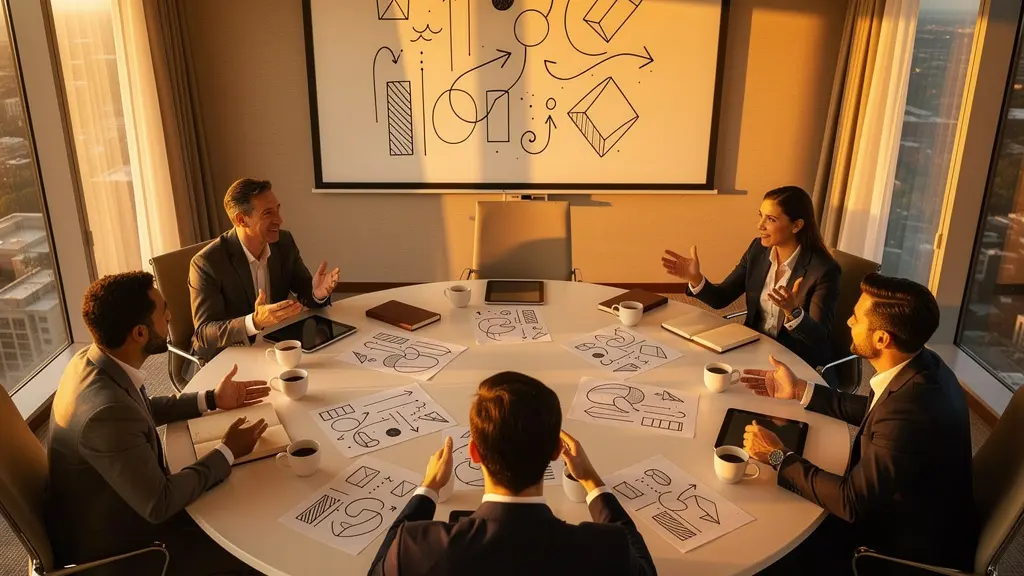
During this session, each manager reports their findings as they relate to the primary mission. The goal is to cross-reference information, identify recurring themes, and discard irrelevant “noise.” This daily synthesis is what builds momentum and transforms individual notes into a coherent, actionable strategy. It ensures the team returns with a unified plan, not a collection of fragmented ideas.
By framing the trip as a collective mission, you elevate your managers from passive attendees to active stakeholders in the company’s strategic future. They return not just motivated, but aligned and armed with a shared plan of attack.
The Post-Con Crash: How to Execute Your New Ideas Before Motivation Fades?
You return from the convention with a notebook full of ideas and a surge of motivation. By the following Monday, you’re buried in a mountain of emails, and the notebook gets shelved. This is the “Post-Convention Crash,” where good intentions die. The failure to bridge the gap between idea and action is staggeringly common; meeting effectiveness research shows that 67% of meetings are considered failures by executives precisely because they don’t lead to a decision or action. Your mission is to defy this statistic with a rigid execution protocol.
Motivation is a depreciating asset. It has a 48-hour half-life. Therefore, the work of implementation must begin immediately upon your return, before you even open your primary email inbox. Your new ideas are the most valuable asset you’ve brought back; they must be treated as such. You need a system to process, prioritize, and delegate these ideas into concrete actions before the momentum is lost.
This is not a casual review; it is a structured debriefing and deployment process. It is the single most important activity in securing a positive ROI from your trip. A disciplined framework ensures that inspiration is converted into tangible business outcomes. The following checklist provides a non-negotiable protocol for the 48 hours after you return.
Your Post-Convention Execution Protocol
- The First 48 Hours: Block 3 hours on your calendar for “Convention Debrief” immediately upon return. This is sacred time. Process your notes, contacts, and ideas before engaging with the regular workflow and its distractions.
- Delegate 3 Quick Wins: From your notes, identify three actionable, low-effort, high-impact tasks. Delegate these to your team immediately with clear deadlines to create instant momentum.
- Accountability Partner System: Schedule a 30-minute check-in call for two weeks post-event with another franchisee you met. Share your top initiative; this external accountability dramatically increases follow-through.
- Single-Threaded Focus: Resist the urge to do everything at once. Choose the ONE major initiative that solves your primary problem and commit to implementing it over the next 30 days. All other ideas are secondary.
- Public Commitment: Announce your “Convention Initiative” to your management team as the top priority for the month. This creates internal accountability and aligns resources.
Executing this protocol is the final, and most critical, phase of your convention mission. It is what separates the attendees from the achievers and guarantees that your investment of time and money yields a measurable return.
The “Toxic Water Cooler”: How to Ignore Bad Advice From Failing Franchisees?
Not all advice is created equal. At any convention, you will find two types of franchisees: the growers and the groaners. The groaners love to congregate at the “toxic water cooler”—be it the hotel bar or the back of a session room—to complain about corporate, lament their performance, and share advice born from a place of frustration, not success. This is the most dangerous “noise” at the event, and your mission is to filter it out with extreme prejudice.
The advice from a struggling franchisee can be seductive because it often validates our own fears and frustrations. It feels good to hear someone else say, “That new marketing program is a waste of money,” if we’ve been skeptical about it. However, this is a cognitive trap. Taking business advice from someone whose business is failing is like taking sailing lessons from a man who is actively sinking.
You need a mental filter to immediately categorize and discard this input. The most effective filter is data. A high-performing franchisee will speak in terms of metrics: “We saw a 15% lift in repeat customers after implementing X.” A struggling franchisee will speak in terms of anecdotes and feelings: “I feel like that new system just doesn’t work for us.” Your job is to listen for the numbers.
Train yourself to mentally discard any input that can’t be backed by numbers. A simple ‘Thanks for the perspective, I’ll think about that’ is a powerful, polite dismissal.
– Franchise Development Expert, Franchise Network Expansion Strategy Guide
When you encounter a “groaner,” be polite but firm. Use the suggested line: “Thanks for the perspective, I’ll think about that.” This acknowledges their input without validating it or committing you to any action. Then, physically walk away and seek out the “growers.” Surround yourself with the people whose results you want to emulate. Your environment and inputs directly dictate your output. Protecting your mindset from the toxicity of failure is a critical defensive maneuver.
What to Ask the Marketing VP During Your Training Lunch Break?
A training lunch break is not a break; it’s an opportunity. You may have a rare, informal window of access to a key corporate executive, like the VP of Marketing. This is not the time for small talk about the weather. This is a targeted intelligence-gathering opportunity. However, you must be hyper-aware of their reality. As recent workplace studies reveal, top executives spend nearly 23 hours per week in meetings, with marketing leaders often citing them as their biggest distraction. Your questions must be sharp, insightful, and respectful of their time.
Your goal is to extract high-level strategic insight that you cannot get from a formal presentation. You want to understand their priorities, their challenges, and their vision for the future. This information allows you to align your local marketing efforts with corporate’s direction, making you a more effective partner and positioning you for future opportunities. Don’t ask questions about your specific location’s problems; ask questions that reveal their strategic thinking.
Here are five strategic questions designed to elicit valuable intelligence, not just simple answers:
- “What are the top 1-2 KPIs your marketing team is being judged on this year?” This tells you exactly what corporate values most right now—is it customer acquisition cost (CAC), lifetime value (LTV), or brand awareness? Align your efforts accordingly.
- “Which marketing experiment from last year didn’t perform as expected, and what was the key learning?” This is a brilliant question. It shows you respect that not everything works and are interested in the wisdom gained from failure, not just the celebration of success.
- “Which customer segment is currently most profitable for the network as a whole?” Their answer might reveal a high-value segment you are currently under-serving in your own territory.
- “Which emerging customer segment are you most excited about for the future?” This gives you a glimpse into the 2-3 year strategy and allows you to start positioning your business ahead of the curve.
- “How are you measuring ROI on our newest national marketing initiatives?” This question shows you are thinking like a business partner, concerned with the financial return of shared investments.
Asking one or two of these questions will instantly differentiate you from the 99% of franchisees who ask for more ad-spend. It shows you are a strategic thinker, and it opens a door for a more meaningful, ongoing dialogue long after the convention ends.
Key Takeaways
- Adopt a Mission Mindset: Shift from being a passive attendee to a disciplined operator on an intelligence-gathering mission. Every action should have a purpose.
- Target Surgically: Focus your networking on a few pre-identified, high-value contacts and your agenda on solving one primary business problem. Quality over quantity.
- Execute Relentlessly: The convention’s ROI is only realized through post-event action. Implement a rigid debrief and execution protocol within 48 hours of returning.
How to Secure “First Right of Refusal” on Adjacent Territories?
For a successful franchisee, growth often means expansion. Securing the “First Right of Refusal” (FROR) on an adjacent, unowned territory is the ultimate strategic prize. This is not something you ask for; it is something you earn. The annual convention is the perfect stage to showcase your readiness and subtly, yet powerfully, make your case to the franchise development team. This is your long-game mission.
The franchisor’s primary goal is to reduce risk. They will award new territories to the operator they believe has the highest probability of success and the lowest probability of creating problems. Your entire convention presence should be a demonstration of you being that low-risk, high-reward partner. It’s about showing, not telling. You must build a compelling, data-backed case for why you are the most logical choice to carry the brand’s flag into new territory.
This is a multi-step campaign that unfolds over the course of the event:
- Present a ‘State of My Territory’ Report: Schedule a brief, pre-planned meeting with your franchise development representative. Come prepared with a one-page report showcasing your key metrics: year-over-year growth, above-average compliance scores, and stellar customer satisfaction data.
- Volunteer as a Mentor: Publicly or privately offer to mentor new franchisees in your region. This demonstrates leadership and a commitment to the system’s overall health, not just your own P&L.
- Showcase Operational Excellence: When you speak to corporate staff or other franchisees, talk about your systems, your well-trained team, and your documented operational standards. Prove you have a scalable model, not just a successful one-off location.
- Frame the Request as Risk Reduction: When you finally broach the subject of the adjacent territory, frame it from their perspective. “I have the team and operational infrastructure in place. Awarding the territory to me would ensure a seamless, on-brand launch and reduce your team’s support burden.”
By consistently demonstrating operational excellence, financial stability, and a team-player mindset, you aren’t just asking for the territory. You are making it the only logical, risk-averse choice for the franchisor.
Stop attending and start executing. Use this framework to transform your next convention from an expense into a strategic investment in your franchise’s future. The discipline you apply during those three days will pay dividends for the next 365.